Winter Birds on Sonoma Overlook Trail

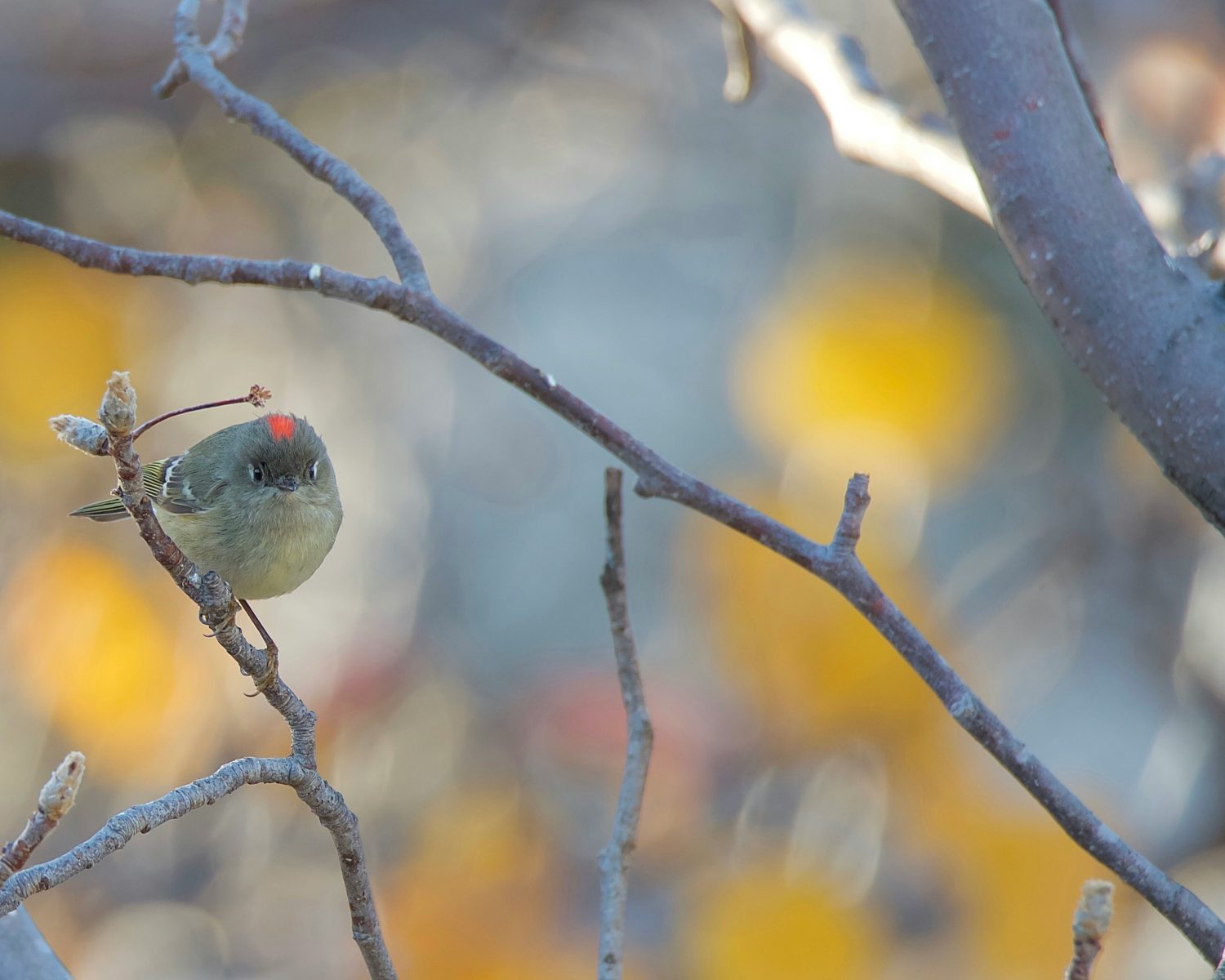
ruby-crowned kinglet

Ruby-crowned kinglet

Winter on Sonoma Overlook Trail brings a quiet beauty, and with it a lively cast of birds that thrive in the cooler, wetter season. As deciduous trees lose their leaves, birds become easier to spot, flitting through oak woodlands, chaparral, and open grasslands.

Who’s over there? Such a restless little bird! A Bewick’s wren, barely five inches long, keeps darting about, looking for tasty insects. Scritch, scraaatch…SQUEAK! And what is that? A male Anna’s hummingbird with its raspy call. When it makes a sharp dive, air passing over its tail feathers creates the loud squeak. Its crown and throat are brilliant, iridescent red. Look for this fellow at the ends of bare branches. How is that woodpecker walking vertically up a tree? It has two toes facing forward, and two facing backwards to keep it from falling backwards. This little “ladder-backed” woodpecker, a Nuttall’s, is just seven inches long. It forages for insects as it circles tree trunks and branches.

Dark-eyed junco

Dark-eyed junco

Resident birds remain active year-round, relying on familiar territories to survive the colder months. Dark-eyed juncos and California towhees hop among the leaf litter at the trail’s edge, while Ruby-crowned kinglets and Oak titmice flit among leafless branches, searching for insects.

A Toyon shrub, also known as California Holly, full of red berries is an ideal stop for a flock of Cedar waxwings. When other fruit is scarce, the Toyon feeds these beautiful birds. As one nears the Upper Loop, the open skyline reveals Red-tailed hawks and Turkey vultures soaring over our rolling hills. Turkey vultures are nature’s garbage collectors–they eat carrion so it doesn’t sit around too long.
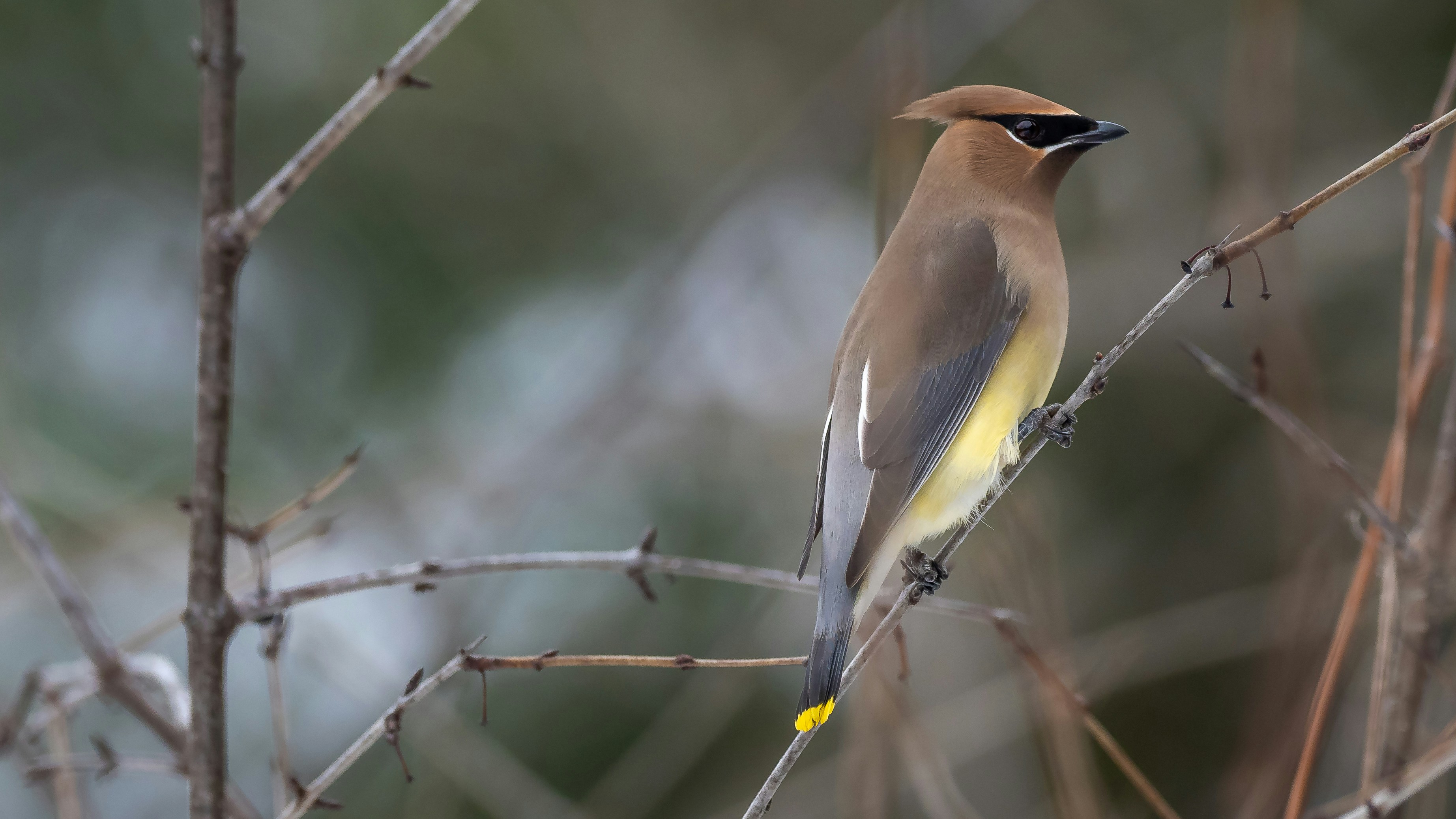
Cedar waxwing

Cedar waxwing

Winter birds play a vital role in Sonoma’s ecosystems, dispersing seeds and controlling insects. They also bring joy to winter hikers.

by Jaqueline Steuer, Sonoma Overlook Trail Steward
Photos: Unsplash
Grateful

A rafter of wild turkeys relaxing on Montini Open Space Preserve last evening, fate working in their favor another year.

Happy Thanksgiving to you all; we hope to see you on the trail during this very lush, thriving time on Montini and the Overlook!

New Trail Video

Sonoma Overlook Trail & Montini Preserve from Roy Tennant on Vimeo.

Why We Fight

I’ve posted a lot about invasive species removal from the Overlook and Montini Preserve properties. Anyone but me would likely say too much, and who could blame them? Not me.

But in reviewing what I’ve written over the years about it, I realized I’ve never explained why we fight this fight. So now I rush to make good this oversight, and try to explain why I go out, nearly every day I can from January through July or beyond, and fight something that will very likely never be defeated.

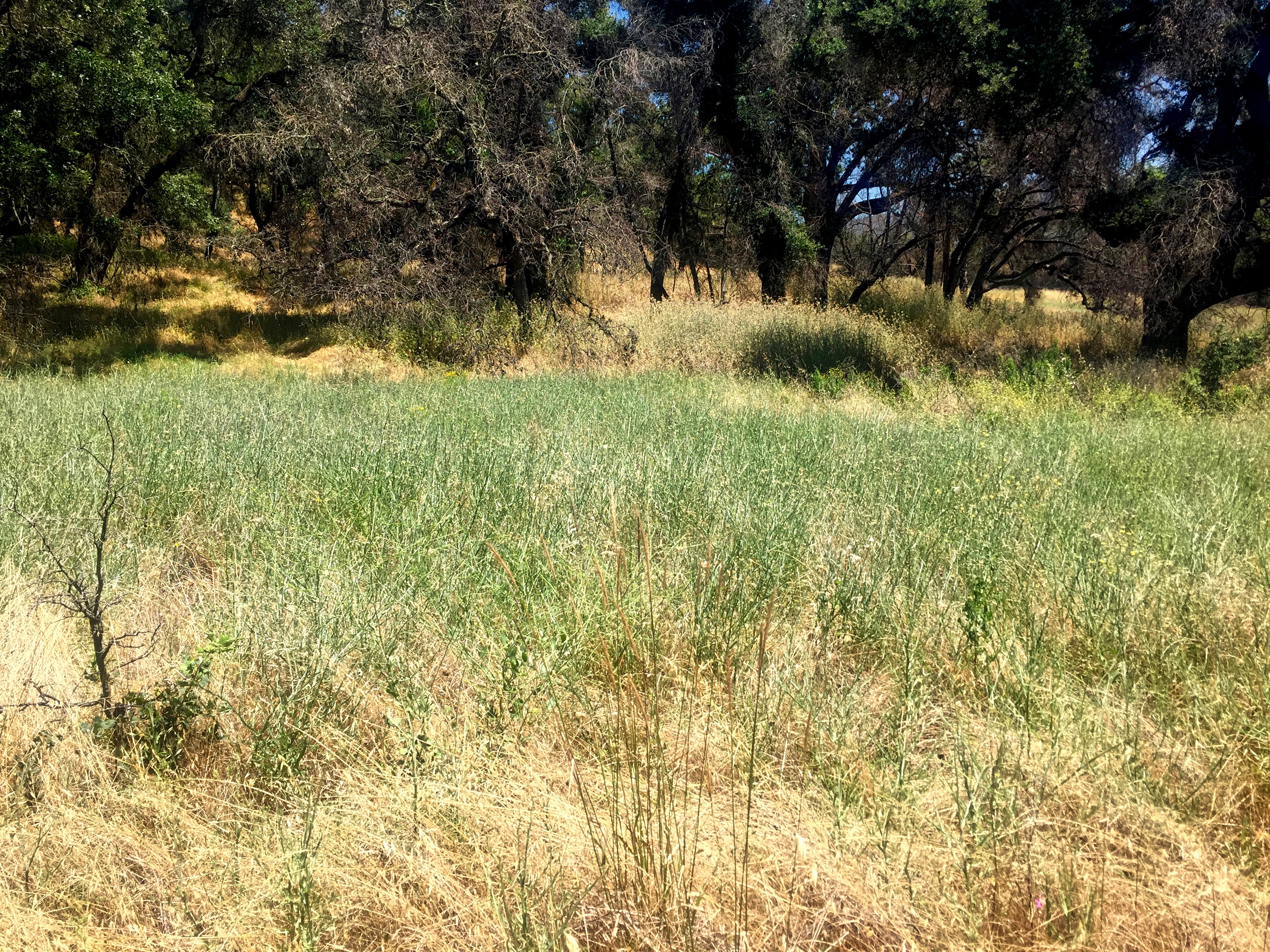
First and foremost, it’s necessary to highlight the fact that species such as Italian and yellow star thistle will completely take over an ecosystem. You don’t need to go far to see this happening. The picture here was taken at the Sonoma Valley Regional Park, and shows how Yellow star thistle in the foreground, and Italian thistle in the background, have essentially taken over a meadow. This crowds out native plant species and even mammals.

Thistle creates a “no-go” area for wildlife, who avoid such patches until they can’t be avoided at all, and then they move elsewhere. This of course leads to a an ever-increasing monoculture and “dead zone” where only the invasive species thrive. “Invasive species are among the leading threats to native wildlife,” states the National Wildlife Federation, “Approximately 42 percent of threatened or endangered species are at risk due to invasive species.” This is clearly a serious threat that must be addressed.

The impacts of this monoculture are many. Wildlife doesn’t have the food sources they should. The lack of diversity in plant life affects the diversity of everything else — insects, reptiles, birds, and mammals.

Invasive species can also affect the chemistry of the soil, as well as the intensity of wildfires.

There are, then, many reasons why we fight this fight.

Recently as I walked along the main path in the Sonoma Valley Regional Park, I was in despair seeing the extent of Italian and Yellow star thistle invasion. It was heartbreaking to see. But I had to turn away, knowing that I have my own battle to fight on the Overlook and Montini Preserve properties. Thankfully, the Yellow star thistle is nearly eradicated on those properties except right along, and next to, Norrbom Road. But we have a long, long way to go against the Italian thistle, let alone Scotch and/or French broom and other invasive species that we have yet to assess, let alone seriously address.

In the end, we fight this fight because the alternative is so much worse. We fight because we love the native ecosystem and we believe deeply in saving it. We fight because we have no choice but to do so, loving these properties and trails as we do. Frankly, that’s the absolute best reason ever to fight for something — for love. So if you see me or my comrades out there, with a large bag and a glove, you’ll know what we are doing. We are fighting for something we love.

That’s why we fight.

Oh, Spring!

Spring is the season of renewal, which manifests itself out in the wild in a myriad of interesting and beautiful ways. Certainly the abundance of wildflowers is an obvious example of spring, but it’s by no means the only sign. In certain areas of the state, we were blessed with a “super bloom” of rather massive proportions that was truly something to see. Entire hillsides were painted with orange, or purple, or blue wildflowers. I was in the Merced River canyon just outside Yosemite in April and you could look up and see an entire hillside of California poppies. So…yeah, wildflowers are, I assert, one of the most beloved signs of spring.

But of course there are others.

Once the Western fence lizard makes an appearance, you know spring has sprung. These reptiles need warmth to be able to move around, so once the weather gets warmer they will be seen on the trail. They are definitely our friends in a particular way. “Studies have shown,” Wikipedia tells us, “Lyme disease is lower in areas where the lizards occur. When ticks carrying Lyme disease feed on these lizards’ blood (which they commonly do, especially around their ears), a protein in the lizard’s blood kills the bacterium in the tick that causes Lyme disease.” And since another sign of spring is the presence of ticks, the timing is fortunate.

Other reptiles such as snakes are frequently spotted in spring, as they are out and about looking for a mate. Many mammals are as well. Just today on the Montini Preserve I saw a male wild turkey in full display, trying to attract a mate from a bevy of females (see picture, the females were out of the frame). A couple females were fighting, I presume over the right to go after this fine specimen. Oh how I wish females would fight over me, but then I’m not nearly as good looking as a turkey. Sigh…