The Beginning of the End

We’ve been working well over a decade to get to this very day.

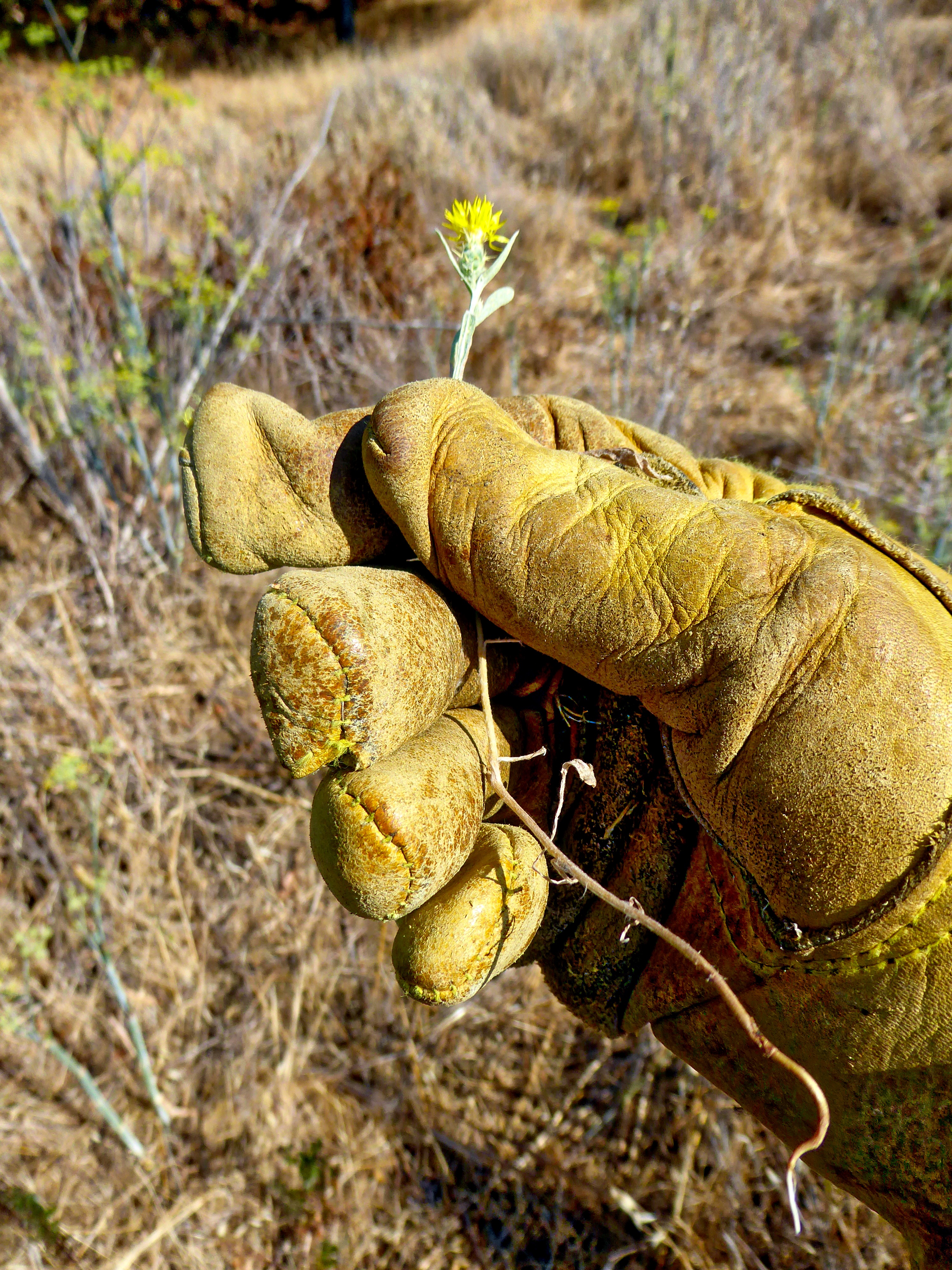
We’ve worked that long to control, and eventually eradicate, Yellow Starthistle. This year, for the first time ever, we’ve pulled every single plant we could find, no matter how small (see picture).

It’s frankly hard for me to describe what this means to me. It has been a long fight, and one, in recent years, that I’ve spent a great deal of time on during thistle season (January to August). The only thing thing in the last few years that has kept me from doing this activity, frankly, is hiking with friends and travel. If I don’t have a hike scheduled with my wife or a friend, or travel, I’m out there pulling either Italian thistle (the season which has ended), or Yellow Starthistle.

This year is no different in that regard, but it is very different in terms of what is left. We are, finally, reaching the end of life for Yellow Starthistle on the Sonoma Overlook Trail and Montini Preserve.

After going out to all the areas that used to have Yellow Starthistle, and repeatedly checking them, I can finally say, for the very first time, that it is completely gone this year — at least as completely gone as is humanly possible.

Let’s just say that when it comes to Yellow Starthistle this year, it’s the beginning of the end. Finally.

Coming in Hot

You guessed it, yet another invasive species post. You can check out right now if this doesn’t appeal. I would be the last person to fault you for it. For those of us who do it, we recognize it as the obsession that it is. We don’t expect anyone else to be so afflicted Like, EVER.

If you’re still here, this is what’s happening. I’m laser-focused on pulling all of the Yellow Starthistle I can possibly find, as it is blooming now, and racing into seed. And yet we have a window of opportunity to make a serious dent in it this season. We are down to just some areas along Norrbom Road, and after hitting it hard last year, the impact is very evident. I’m finding much less than last year in these areas. 

This affords us the opportunity, for the first time ever, of potentially pulling every single plant we see

That’s why I’m fired up, and going out there every day I can, and pulling every single plant that I can, no matter how small. Because that’s how you reach your goal. Because that’s what it takes to completely eradicate an invasive species from 200 acres of public lands.

If you can’t do what’s required to come in hot, then you have no business taking this on in the first place. Just trust me on that.

It Seems Impossible, Until Suddenly It Isn’t

New findings could improve diagnosis, treatment of depression | Berkeley NewsToday, as most days, I was out pulling Italian thistle on the Montini Preserve. This is what I call a “long game,” and if anyone knows how such games are played, it’s me. I’ve even written my own (as yet unpublished) essay about it. Long games are played by long, concerted effort over years and decades, one day at a time. I’ve also called it being gently powerful. I know this. But I still have my good days and my bad. Today was the latter.

I decided to tackle a patch that I figured I could knock out in an hour of concerted effort (think simultaneous two-handed pulling). I was wrong. When I realized how wrong I was, I had to walk away. As I left the trailside to go down the hill, I noticed a rock above Red Quarry that was perfect for sitting — flat and at the right height. I was right, the rock was perfect. I sat down and looked around. I inevitably looked down and that’s when I saw yet even more Italian thistle. The area also looked a bit trampled, as if this was a familiar rock to one or more people who visited it to smoke dope or just hang out.

Since invasive species work can be an obsession, I pulled what I saw and then moved back toward the trail, where I found yet another patch that I mostly pulled. But that’s when the depression really set in. In this one small area, I had a big patch and two smaller patches. I then mentally multiplied it by the size of the two properties (the Sonoma Overlook Trail and the Montini Preserve) where I have committed to do this work. Let’s just say I’ve had better days.

Later, at home, I decided to rewatch the trail movie that I made last year. Not only do I enjoy seeing the trail scenes and all of the flowers, insects, mammals, and birds of the trail I also feel like it naturally lowers my blood pressure (let’s just say it’s a theory). But I made an astonishing (to me) discovery. One of the photos in the movie is from several years ago, and as soon as I saw it, I recognized a spot on the trail that was covered in Italian thistle. THEN. Not NOW. This clear evidence of progress literally brought tears to my eyes. I AM making a difference.

I was then reminded of something Nelson Mandela once said, that I will take the liberty of rephrasing, without changing the meaning: “Something can seem impossible until suddenly it isn’t.” I just had to have my down day, and then move on. As one does, when playing the long game.

All Clear, For Now

Poison oak.

Today I finished inspecting all of the maintained trails of the Sonoma Overlook Trail and Montini Preserve properties. As of today, the trails are clear of Italian thistle and poison oak to about three feet away from the trail. We achieved this milestone more than two months earlier than last season, which now means we can move on to other tasks and goals in our Vegetation Management Program. Trailside can now be moved to “maintenance” status from “attack,” which means we will need to continually check and monitor the trails, as new thistle comes in all the time, and poison oak keeps growing, of course, but we will now begin attacking other areas.

This essentially means a couple tasks: 1) continuing to push Italian thistle away from the trail, and perhaps eradicating it completely in some areas, and 2) being opportunistic in attacking patches that are in danger of furthering the spread of thistle on both properties. In general, the Overlook is in better shape than the Montini, so typically I spend more time on the Montini, although my goal this year is to eradicate thistle from some specific areas on the Overlook where it appears we have a chance to completely eradicate it.

Be sure to let me know if you want to help with this exciting (haha) work!

February 1 is Roy Tennant Day in Sonoma

Roy Tennant receives the Celebrate Sonoma Award in recognition of his uncommon dedication and hard work on the Sonoma Overlook Trail.

Roy Tennant is a stalwart member of the Sonoma Overlook Trail Stewards. For over 10 years, Roy has spent literally thousands of hours in his goal to remove invasive species not only on the Overlook Trail and surrounds but also on the Montini Preserve.  He is dedicated, he is persistent and he is absolutely relentless in his efforts. 

Invasive species threaten our ecosystem. They take hold and grow quickly, crowding out native plants that are the source of food and shelter for birds, mammals, insects, and reptiles. Roy intelligently, methodically and organically pursues Italian Thistle, Yellow Star Thistle and Broom not only within 6 feet of the trail but also in meadow areas where these species threaten to take hold. 

Trail walkers and runners are very familiar with Roy, as they see him at work practically every day between January and August removing poison oak that encroaches the trail or attacking his targets and hauling off his thistle and broom winnings.

Roy serves in many capacities as an active Overlook Trail Steward volunteer including trail repair, downed tree removal, answering questions from walkers, and participation on the map and signs committee.  Yet, his passion is the removal of invasive species. Through the website he manages, “overlookmontini.org”, Roy also educates the public about the problems of invasive species and encourages active participation from the public. His work is truly exceptional.

A “Celebrate Sonoma” Certificate of Recognition in honor of Roy Tennant, an outstanding City Volunteer and Overlook Steward extraordinaire will be presented at the City Council meeting February 1 by Vice Mayor Harvey.