Building an Armored Swale

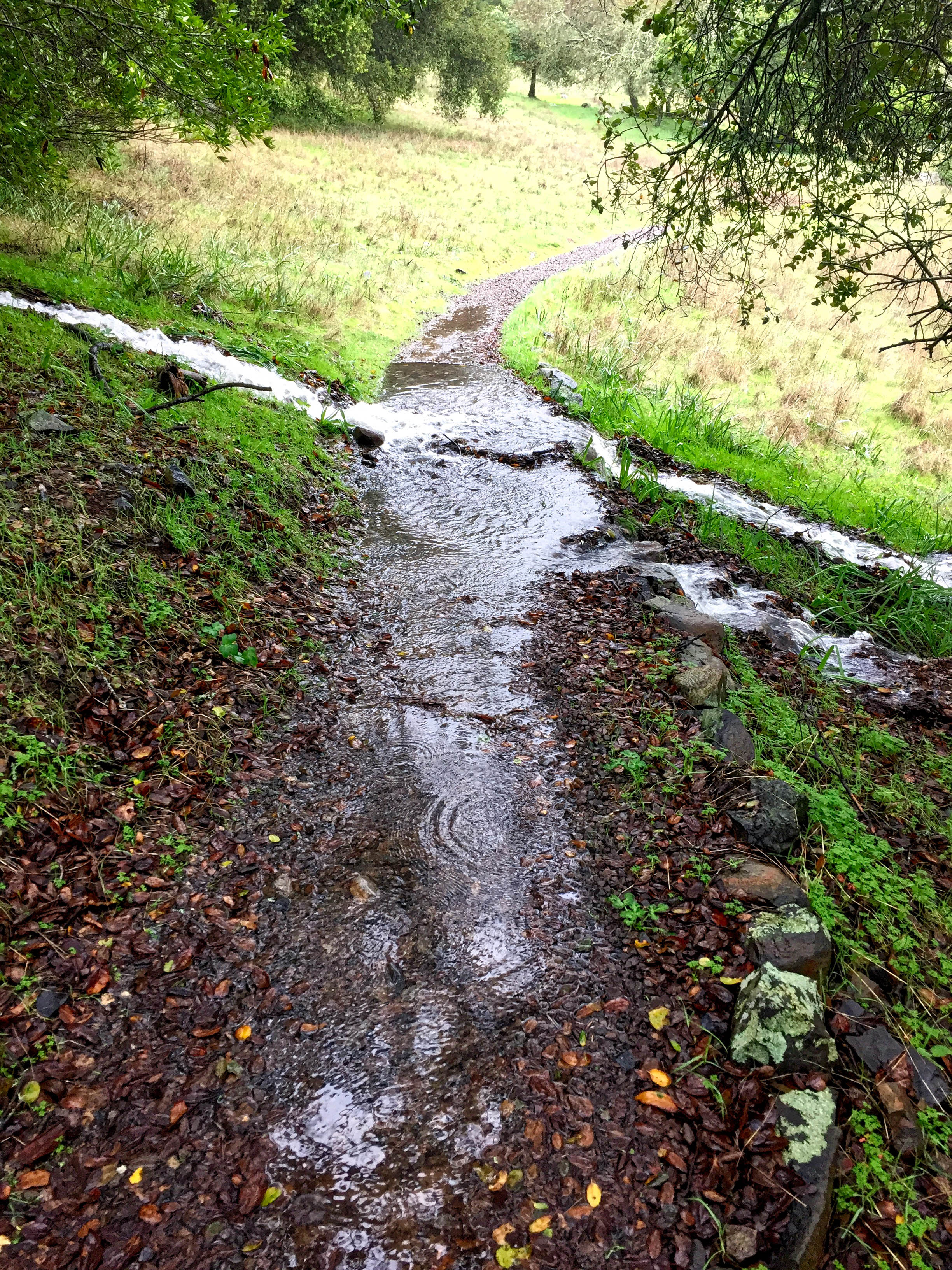
Today Jess and I (both volunteer stewards) tackled a Montini trail project that I had long planned. There was a place on the Rattlesnake Cutoff Trail where water, during heavy storms, would flow across the trail. Since the initial construction of the trail didn’t take this into account, the water would pool on the trail, leading to a long trail segment that would essentially turn into a tiny lake (see photo).

The Montini Preserve was heavily mined in the early 1900s (this property and adjoining Schocken Hill, now the Sonoma Overlook Trail, essentially paved the streets of San Francisco at the time), and there is a quarry “divot” in the hill above that collects rainwater and funnels it out to the trail. Being essentially bedrock, the water has nowhere to go but out and down. 

What the trail needed is what’s called an “armored swale,” which is essentially a channel cut into the trail that is protected by a floor of rocks to prevent erosion. I had been waiting for rain to soften the soil, as we would first need to excavate the existing rocks and in summer the ground is like concrete. It rained yesterday, so the soil was going to be about as soft as it was going to get. Also, since I knew that an “atmospheric river” was set to dump several inches of rain in a matter of a few days, now was the time to act.

So Jess and I went out today and built it. We first needed to excavate a channel across the trail, then place stones to protect from erosion, and fill in gravel and soil around the stones. Do your worst, atmospheric river; we’re ready for you!

Ten Plants a Hike

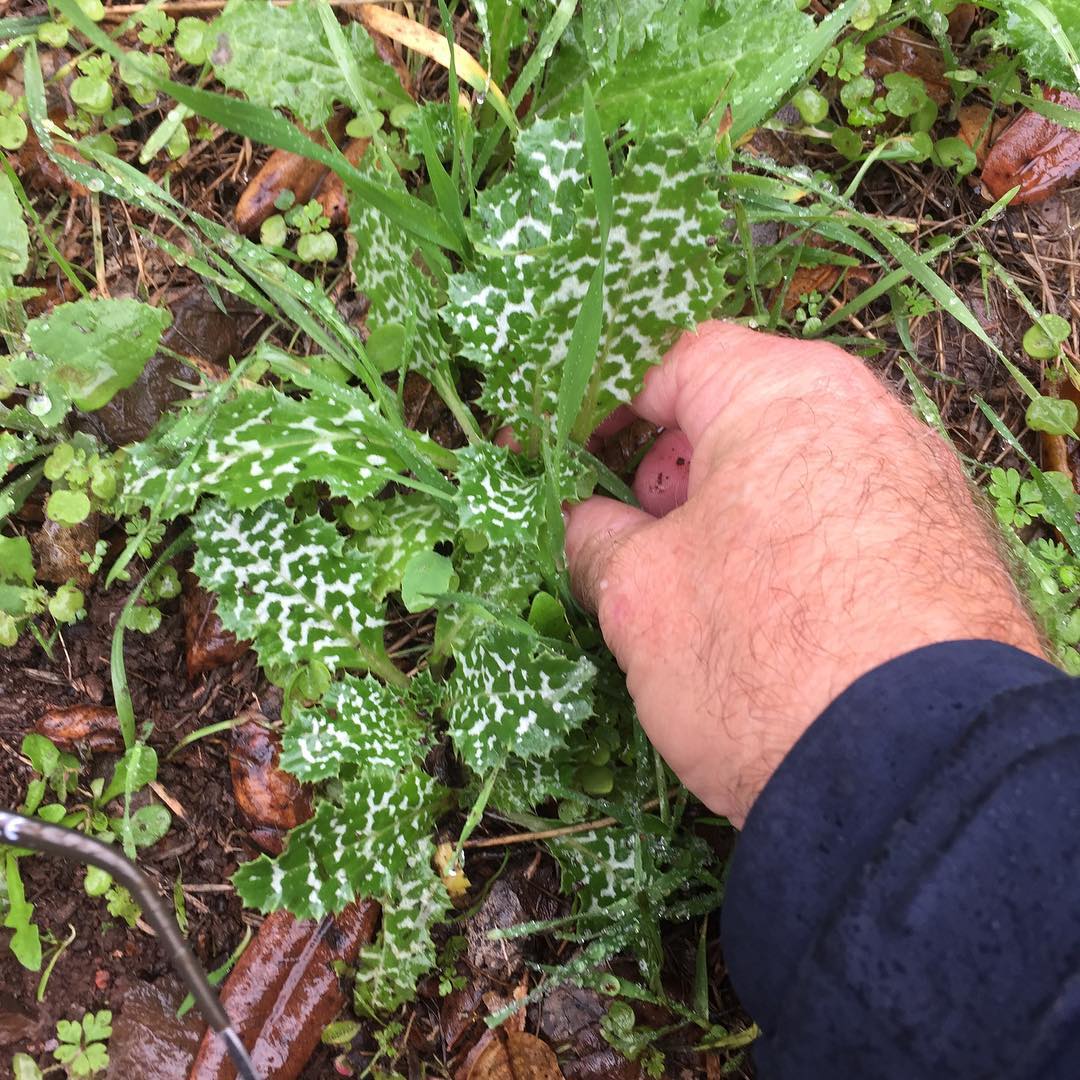
A young Italian thistle plant.

January (and sometimes even December) is the beginning of what is essentially an eight-month season of invasive species removal work. Beginning with Italian thistle (pictured), work proceeds against a variety of non-native plants that threaten our trails and the lands they traverse. Although we’ve made great progress against Yellow Star thistle, Italian thistle is much more prevalent and dispersed, and it is now the primary species we are working to control.

The problem is that it has a big head start. It can be found in many areas of both the Sonoma Overlook Trail and the Montini Preserve, and is especially prevalent along the trails on the Montini. Meanwhile, we have little person power to throw at it. Until now.

I have a simple ask. Every time you hike the trails, do us all a favor and pull ten plants. That’s all I ask. Ten plants. Anyone can do that. You can do that. Imagine this: if ten hikers do this for ten days they will have collectively pulled one thousand plants. That represents substantial progress.

And now is the perfect time to do it – the soil is damp and soft, the plants are small and can be just pulled and tossed aside, and their roots are not yet well developed. They are easy to spot, as they are bright green, and they have spiny leaves, whereas most other plants do not (see photo).

Tell you what, you can even tell it that it’s days are numbered as you pull, or “We’re coming for you!” Whatever floats your boat. Plus, I won’t actually make you count. I trust you. Just do what you think is likely ten plants and we’re good. But if you do what I think you might, soon you’ll find yourself drifting past ten with nary a second thought. And that’s just fine too.

Ten plants a hike, that’s all I ask.

A Long Day’s Journey Into the Fight

Those of you who read this blog regularly (thank you both!) know that I have, well, an obsession about ridding these properties of invasive species — particularly invasive thistle, as it can create entire “no go zones” for wildlife, and completely up-end the natural ecosystem. If you want to know more about why we fight it so hard, here is the chapter and verse about why we do what we do.

But at the moment, in December, we are still in the “down period,” when we can rest, and recuperate from the long removal season. You see, the thistle season begins in January — or even the end of December — and it extends well into August. Thus, we have eight months on, essentially, and four off.

So perhaps you can understand what I’m feeling as I spend my last few weeks as a free person before buckling down in January for another eight months. I’ve enjoyed hiking the last several months a lot. I’ll still hike during thistle season, but usually just when a friend can come along. Otherwise, I’ll be out there, pulling like always. I rush to say, however, that every year it gets better, and there may come a time when there is even no thistle at all. But we’re not there yet.

That’s why, if you see me out there in January, pulling Italian Thistle (pictured), you’ll know it’s a long game, fought over years and decades, and at least I’ve had four months off to simply enjoy the properties that we are fighting to save. And like I said, every year it gets better. Before very long, I believe, I will have 12 months to hike. I can’t wait.

Prepping the Trails for Rain

Since rain was predicted for today (and it came!) I headed out earlier in the week with a mattock to clear trail drainage channels, which had become clogged with rocks, leaves and miscellaneous debris since spring. Water must be guided off our trails immediately or else it will erode the trail and harm it, especially over time. Plus we don’t want the soil that gets eroded to end up in our waterways.

I also cut new ones where I thought they may be needed. Some of this work is obvious, but I know that additional work will be needed once we actually have flowing water on the trails and can see the trouble spots, where water is pooling or running down the trail.

This is just one task that the volunteer stewards group does throughout the year to keep our trails safe and well-maintained.


The End of Invasive Broom

One small portion of where the action happened.

Sorry, the title is a bit over the top, but titles should be dramatic, or at least evocative, I assert. In reality, it is the end of invasive broom this season. We will likely need to return to the big patch I removed recently in subsequent years, with vigilance and due diligence. But at least, for now, it’s gone. This is the first time this has happened on the Sonoma Overlook Trail property.  The Montini Preserve has never had broom, as far as we can determine.

Accomplishing this took several weeks of effort, an hour almost every day. I even began to get a repetitive stress injury from pulling too much with my right arm, and had to back off a bit. Pulling broom is harder than pulling thistle — so much harder that I had to buy a special tool to pull the largest plants. Called the “Weed Wrench” (see photo to the left), it is a rather imposing chunk of metal that mechanically allows you to grip the broom at its base and lever it from the ground. Although they call the one I bought their “light” version, I think it could be designed to be a lot lighter than it is. But whatever, at least it works.

One day, when doing this work, I returned to my car to discover I was without my keys — they had fallen from my pocket as I was pulling. I had to go  retrace my steps at least three times, from my car to the patch, around the patch and back, before I finally saw a sparkle in the forest duff from the tiny, bright green flashlight on my keychain. I was grateful.

I’m also grateful that we are making significant progress on fighting invasive species on these properties. We are winning, as every year it gets better. We are still far from the end, but I think I’m beginning to at least see that it’s possible to win. For a number of years, I had to take it only on faith. Now I have experience and a sense of surety. We can do this. I know we can.