Fundraiser for the Overlook Trail

Sonoma Overlook Trail Stewards Fundraiser

Haywood Ranch and Vineyard

Sunday September 27th, 2015 10AM – 1PM

We would love to see you all out to support the trail, enjoy a good walk, lunch and lovely people!

RSVP required Cost $35.00

Help us keep the Overlook Trail well maintained and lovely as ever by participating in a quintessential Sonoma event. Come walk with us through the Haywood vineyards with award winning winemaker Peter Haywood. We’ll meet at the ranch where the Haywoods live and work, walk through the vineyards, returning to the ranch for a simple lunch made with some locally grown ingredients. Haywood wine was the dream of noted winemaker Peter Haywood, one of the early developers of the zinfandel varietal in Sonoma Valley. Set in the midst of vineyards that are bursting with some of the most highly regarded wine grapes in the region; the site has a feeling of vigor and excitement generated by the forces of nature at work all around.

With over 180 secluded acres, 40 acres are devoted predominately to zinfandel grapes. We’ll have the opportunity to walk through the vines and pause by one of the two ponds to listen to the special stillness broken only by the chatter of birds. For those more ambitious hikers, we can continue our walk up the hillside, lined with boulders, and consider the feat of the hardy pioneers who quarried this stone to build the streets of San Francisco. Haywood produces 3 Los Chamizal Zinfandels: Los Chamizal, Rocky Terrace and Morning Sun.

RSVP To Laurie Friedeman to reserve your space – MVRLSF@aol.com

The Sonoma Overlook Trail is a non profit EIN # 94-313-6500. The trail is run and maintained by volunteers. All proceeds from this event will benefit the Sonoma Overlook Trail.

Thank you to Sonoma Market for their generous support!

SonomaMarketLogo

Permanent Signs Come to the Montini Preserve

P1000721Although the Montini Preserve has been open to hikers since November 2014, we are only now getting permanent trail signage. The signs are screwed into metal posts set in concrete, so they seem sturdy and lasting. The metal is unpainted, so over time they will likely rust to a red color.

The signs point out trail names and paths as well as areas of the Preserve that are “off limits”. These “off limits” areas are near the property border, and include such high-traffic areas as a “rogue” trail that connects Two Goat Point to a ranch road that takes hikers back down to the Holstein Hill Trail. It seems highly unlikely that hikers will heed the signs that prevent them from making a broad loop around the Preserve, but the terms of the agreement apparently dictate such an admonition.

P1000720The signs themselves are small but picturesque, and some of them include a “City of Sonoma” attribution with the city seal. They are a great addition to the property, and overdue.

On the Sonoma Overlook Trail, the signs are typically wooden post signs, which are a lot easier to put in but may be less durable than the Montini signs.

The City of Sonoma to the Rescue

P1000569

Before.

This past year two trees have fallen across the trail, and in some kind of freak coincidence they were both at head level (see pic of the 2nd one). As you can imagine, this presents a particular hazard to hikers — and especially runners. Thankfully, the City of Sonoma Public Works Department has been very good at responding quickly to these situations, and in both cases were able to remove the tree within a day or two of it being reported. We are sincerely thankful for this, as the volunteers who do much of the other maintenance of the trail do not always have the necessary equipment and skills to deal with a large fallen tree.

So although the group of volunteer stewards are responsible for many of the smaller maintenance activities, such as cutting channels to move water off the trail as quickly as possible, some of the larger, more complex tasks require City staff involvement. The City of Sonoma owns the property, as they also now do for the contiguous Montini Preserve, so this makes sense.

P1000695

After.

This is a great example of collaboration between volunteers and the City to maintain a safe and enjoyable trail experience.

End of Season Star Thistle Report

endofseasonEarlier I posted about starting the yearly battle with Yellow Star Thistle (YST). YST is an invasive non-native weed that left unchecked can take over entire meadows (it does not do well in shade). The University of California has this to say about it (in part): “Seed output can be as high at 30,000 seeds per square meter, with about 95% of the seed being viable soon after dispersal. Most seeds germinate within a year of dispersal, but some can remain viable in the soil for more than 3 years.” This is an opponent that is difficult to over-estimate.

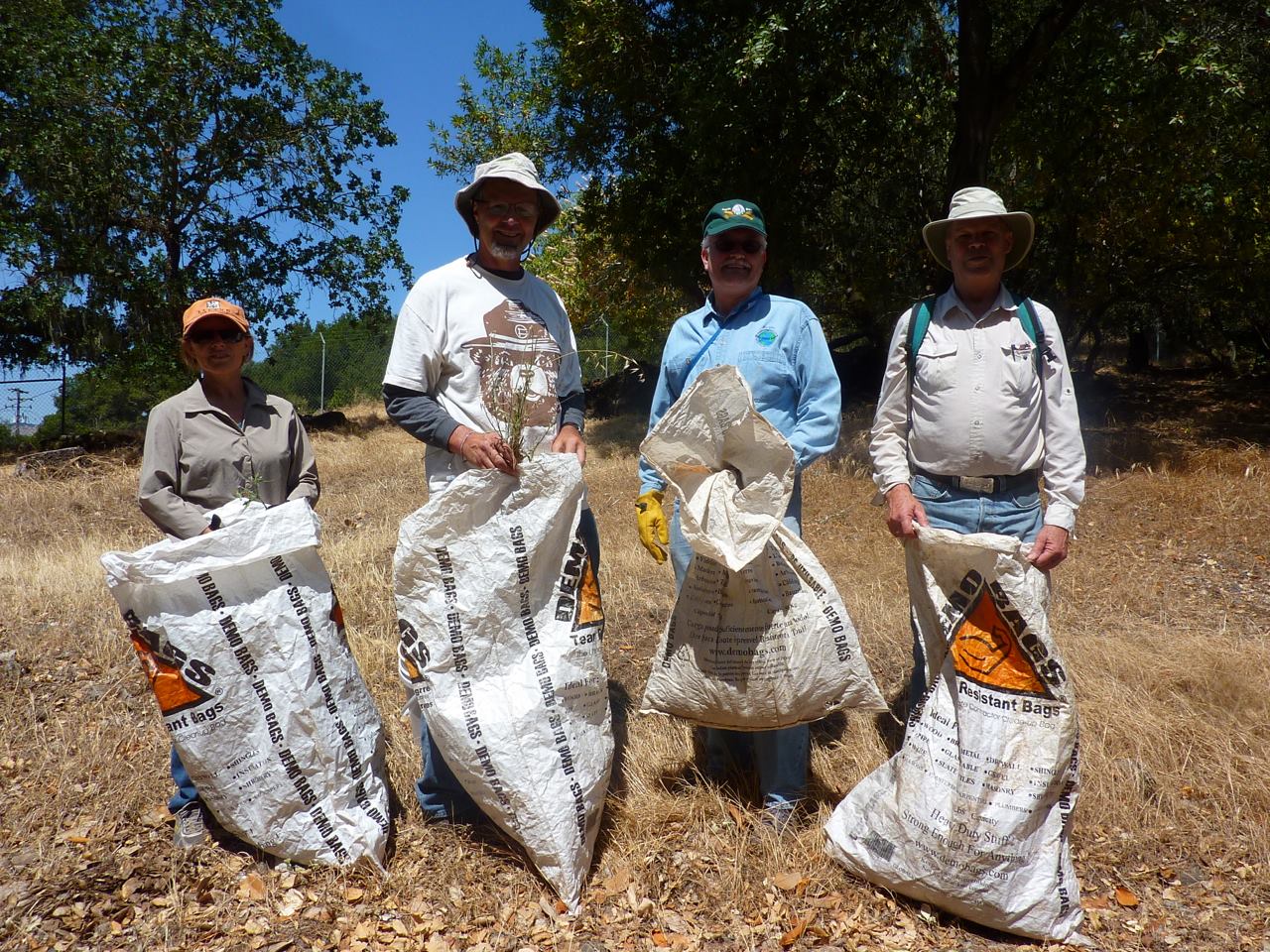
Volunteers are trying to eradicate this plant all over California every summer, as we certainly do here at Jack London State Park (thank you Linda Felt and other volunteers!) and on the Sonoma Overlook and Montini Preserve properties. So we are now in the second year of a relentless 5-year campaign to completely eradicate this scourge.

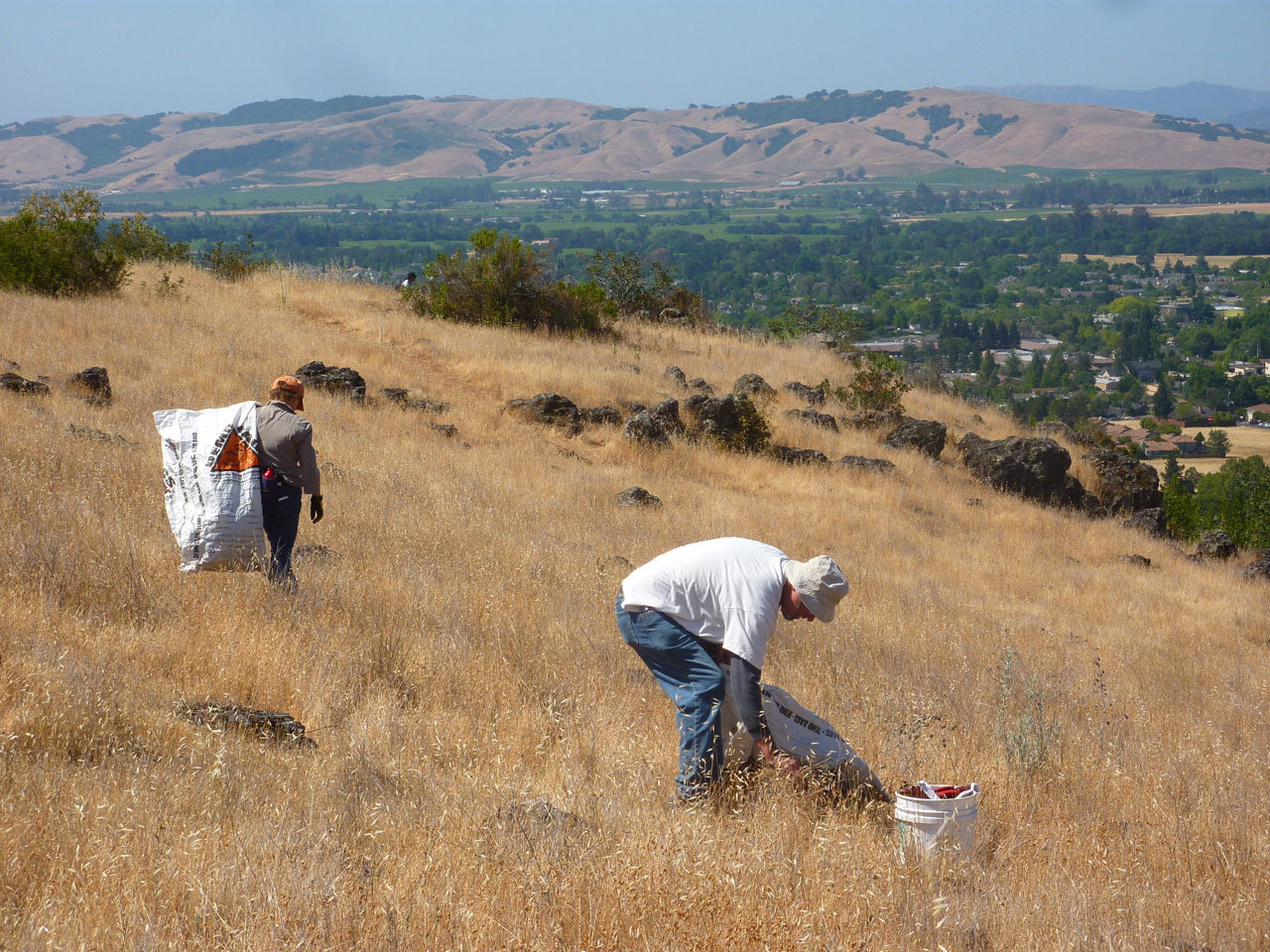
Starting in mid-May, even before it was blooming, I began pulling it on my hikes on Overlook and Montini. Since then I’ve been putting in several hours every week pulling it up by its roots and hiking it out. When tackling a large patch I take a large plastic sack, but recently on the Overlook Trail I have been finding so little (see the picture of a recent haul) that I haven’t bothered to take a bag. Over the summer I’ve racked up at least 30 hours of pulling — not counting the time to get to the locations.

11411656_10152876771541786_840892439594292638_o

Before the battle.

Last year we did such a thorough job on the Overlook Trail that this year it took much less time to keep it in check. The Montini Preserve was another matter, as we hadn’t been checking it last year (it opened to the public in November). I found several significant patches and one really bad patch (see the “before” picture to the left, it covered the entire area pictured and beyond). I was able to get the smaller patches under control with some diligence, but the really bad patch has taken many hours of work spread out over weeks. Only today did I finish clearing this patch (see “after” picture). It’s sweaty work, and raised blisters on my hand even with a glove.

I can now report that as far as I can tell, YST has been effectively removed this season from the main parts of the Montini Preserve and the Sonoma Overlook Trail.

after

After, August 2nd.

One morning recently I arrived at the really bad patch on the Montini Preserve with three large plastic sacks that I intended to fill, as I had several times before. I surveyed the patch that I had been working on for weeks and saw everything that still remained. I thought about giving up. I had made a lot of progress and I thought we could get it all next year. Why not just quit? No one would know.

I took another look around.

Then I stooped down and began to pull.

Call it what it is — an obsession.

The Role of Prey

remainsIn a recent post, I wrote about the role of raptors and other predators. The animals that predators prey upon are also of very important for a healthy ecosystem. It’s also worth pointing out that predators can also be (and often are) prey themselves.

In that prior post, I referred to the now classic case of  ecosystem failure caused through over-hunting predators on the Kaibab Plateau in Arizona. The deer, freed from predation by their natural predators, soon over-populated the area and over-grazed the land. Their impact led to an ecosystem that could support fewer of both prey and predators. So having a balance is important, and human intervention can often lead to tragic consequences.

10995414_10152560511126786_773420903753463030_nTherefore, when I run into the remains of various animals on the trail, I am less dismayed at the fallen animal than I am grateful for their existence and what they contributed to a healthy ecosystem. We need prey. We need predators. We need predators to also, in most cases, be prey as well. It may be that we are the first predator and prey that has largely escaped one of these roles, except, it must be pointed out, from ourselves.

In the end, humans are the most deadly predator of them all.