
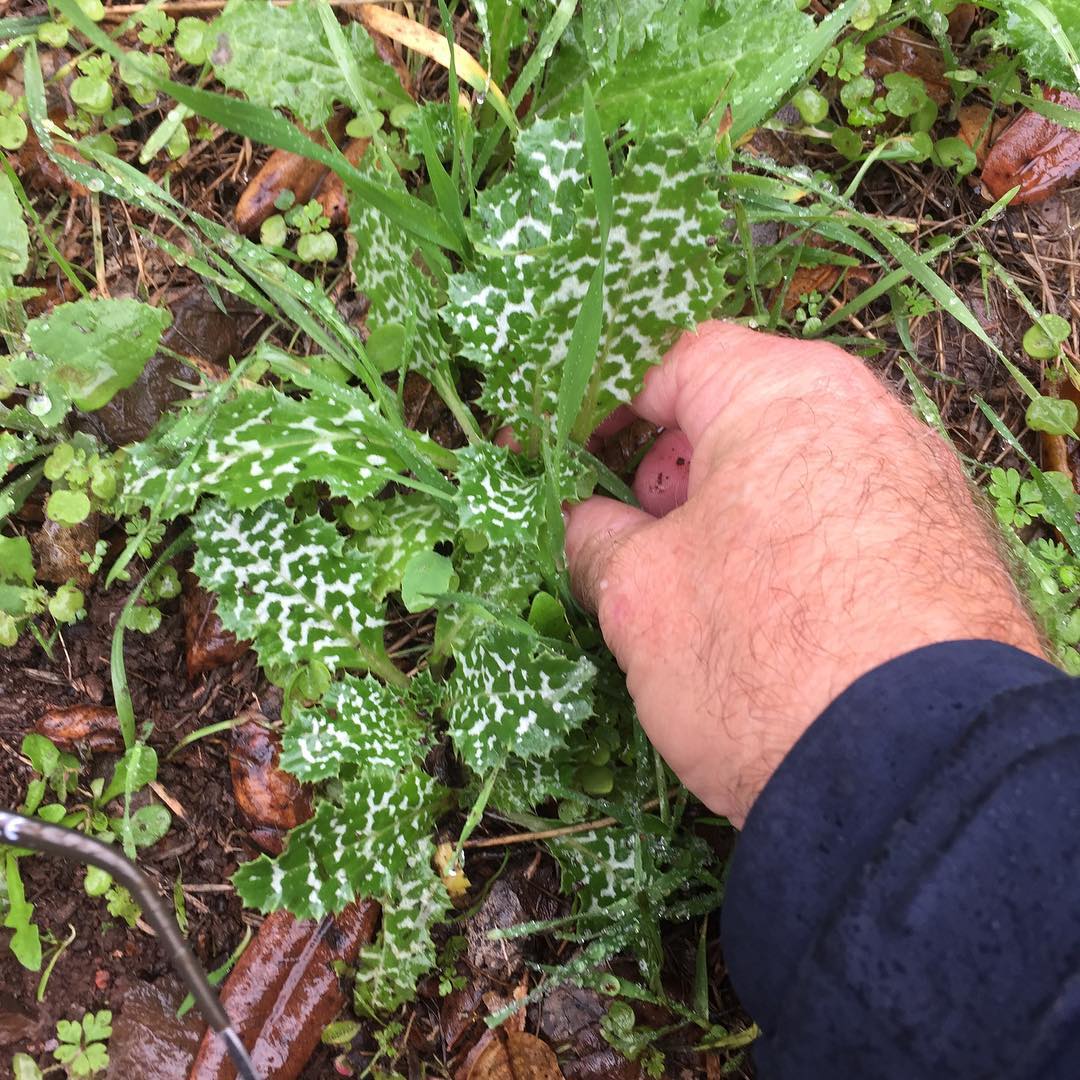
Pulling an Italian Thistle in its early stage.
At the risk of completely turning off our loyal readers (Hi Mom!), I once again sally forth into the area of invasive species removal, but this time it’s to describe some “lessons learned,” after years of doing this work. But if you read beyond this point you may want to see your psychiatrist. Just a friendly warning. Jump to the end of this post if you don’t believe me.
It’s worth noting that in doing this work we seek to be two things only: 1) intelligently methodical, and 2) absolutely relentless. We believe that this is the only way we can possibly be successful.
They’re called “invasive species” for good reason. Native plant species have existed in a particular ecosystem for many years, decades, even millennia. So when a new plant species is introduced into an area, the local ecosystem often has no defenses against it. This can (and often does) allow the invasive species the opportunity to completely take over the local ecosystem, thereby crowding out native species until there is essentially a monoculture. I’ve seen this happen. One of the first things to understand, then, is that this is a very real threat, and one that we have not always been good at fighting.
It’s not a battle, it’s a war of attrition. Don’t think that this is a battle that can be fully won. All we can hope to accomplish is to reduce the level of invasion to a manageable level and keep it there, or reduce it over time. We may be successful in keeping a particular species off the properties completely, with due diligence over years and constant vigilance, but we will likely never completely rid these properties of invasive species altogether. It’s just what it is. Know this going in.
Don’t look up. Invasive species removal is what’s called a long game — something that takes concerted effort over many years to reach your goals. Think of marriage, or saving for retirement — things that take work over long periods of time to achieve lasting goals. I’ve also called this being gently powerful, as a river is when it erodes very hard rock. The point about not looking up is that if you see the entire job before you, you may despair. But if you keep your head down, and only look at what is in front of you, then you have a chance at going on, and really making a difference in the long term. This is a real issue when it comes to achieving a difficult task like fighting back invasive species.
Look up. No, this is not a negation of the previous point, but merely the fact that sometimes it can really help to break out of the focus of the work you are doing and simply enjoy where you are. Look around, see the wildlife, fell the breeze, look off into the far distance, and just drink it all in. You are here for a reason, but you can also enjoy yourself at the same time. And if you are enjoying yourself, then you are more likely to keep doing the work.
Set achievable goals. When I first started pulling invasive weeds, I had no goals. I just went out and did it. But when I really took it on as a project, I discovered the need to set goals. Initially, in my ignorance, I set the goal of complete eradication. On the Overlook property, that ended up being achievable for the Yellow Star Thistle, since after 5-6 years of concerted effort, we seem to be getting there. But I’m not so sanguine about the Italian Thistle, so I’ve set the much more modest goal of eradicating it from the trail edge for now. Once that is achieved, another goal can be set. But don’t rush it, or you may fall into the trap of frustration.
Manage your discouragement. I don’t know of anyone who does this work who hasn’t had moments of feeling discouraged. Anything that is this daunting is likely to make anyone have feelings of discouragement now and then. How I handle it myself is I ask myself the question that is the verbal equivalent of “don’t look up” — “Are you making a difference?” Invariably, the answer is “Yes, I am.” And that’s how I turn discouragement into determination — by focusing on the small goal of simply making a difference. Just make next year better than this year or the year before.
Know that one plant pulled today means ten you won’t have to pull next year, and a hundred the next. If one plant seeds another ten (just for illustration, the actual number is likely much higher), and those each seed another ten, you can see that very quickly you have exponential growth that quickly becomes uncontrollable. Keeping this in mind can help manage discouragement.
Don’t start at zero tolerance. Part of managing your discouragement is to know that in serious infestations there is no way you can get it all at one time. Don’t even think you can. Understand that you may need to hit the same general area one, two, even half-a-dozen times before you can feel good about it, and don’t sweat it. Only set an area to “zero tolerance” — where you pull everything you see — when the area warrants that designation. It may take you years to get to that point for some areas. It isn’t a failing.
Use a variety of strategies, fit for purpose and timing. When I first began this work, I thought that pulling was the only strategy to use. But over time I realized that we could use a number of different strategies, depending on the situation, the time of year, and other factors. So in the early season I begin with “pull and toss,” then progress to “pull and carry out,” and finally end up at “weed whack”. We are also considering covering patches with plastic and letting the sun burn them. There may be others still. The point is to be flexible, learn, and adjust as needed.
Know that there’s never just one. This is a rookie mistake – thinking that when you spot one invasive weed that’s all there is. As I’ve blogged about before, that is never the case. Just stop thinking that. As soon as you zoom in on that one weed, you will see others — perhaps many others. But there’s never just one.
Sometimes, as odd as it is, there is just one. I only saw this recently. I found one thistle plant and searched for at least 10 feet around it and couldn’t find another. Go figure. But that also means it was a most essential plant to pull, as it was a potential beachhead for a new battle. These outliers are the most important plants to pull. Always.
Understand that not only is it not sexy, it’s not even remotely attractive. Much of this work happens off the trail, where no one sees you doing it. And even when you’re doing it on the trail, you’re sweaty, smelly, and sticking your big butt toward the trail. Believe me on this. It’s not a pretty encounter. Some of you reading this may have even been there, and can back me up on this. I’m sorry.
If you think you’ve won, you haven’t been doing it long enough. When I first started doing this work, I naively thought we could knock it out in a year or two. That was almost a decade ago and there are invasive species we haven’t yet addressed. But that doesn’t mean we haven’t had a serious impact — we totally have. For example, I am proud to report that we’ve essentially eradicated the Yellow Star Thistle (YST) from both the Sonoma Overlook and Montini Preserve properties, after years of work. Also, we have made a serious impact on Italian Thistle on the Overlook Trail property. So there has been progress. But there is also much further to go. Just don’t think we’ve won, because we never really do. But we make a difference, and that is important.
Don’t let one patch get you down. This is a lesson it took me a while to learn. When I found a patch of invasive weeds I thought I needed to pull it all before moving away. But I quickly realized that for my own sanity I would need to take a break, if it only meant attacking a different edge of the patch. Sometimes you just need to walk a bit and restart anew, and that is totally OK. These days, I only work on a patch until I feel like moving on, as I know I will be back tomorrow or the next day to fight it back farther, and eventually, over time, eliminate it. And that’s perfectly OK. Bottom line: only do what you want to do.
Use the seasons to your advantage. Invasive species have their own timetable, and some, like Italian Thistle, come in early, while others, like Yellow Star Thistle, come in later in the season. Meanwhile, you can get Scotch Broom pretty much any time. I’ve been pulling Italian Thistle starting in January, as it becomes to come in, which is a great time to get it, as it can be easy to pull from the wet soil and you can simply toss it aside, rather than hauling it out in a sack as you need to do later in the season. Later in the year I add YST to my itinerary, although as I’ve mentioned it is thankfully becoming more rare.
You need to pull the big plants before you see the small ones. I’ve often been over the same ground multiple times, finding new plants each time. First, you pull the big plants, then you pull the small ones, then you pull the tiny ones you didn’t see before getting the others, or that came on later. It is what it is.
Beware of obsession. I don’t know what to tell you about this. I just know that it’s possible to descend into obsession. Here is even a blog post about it. Just don’t let it happen to you. If you do, I’ll see you out there, and you’ll be welcome.
Lord help you. If you’ve made it this far then I feel for you. You may be in danger of catching the bug, which I’m not sure I would wish on anyone. Pretty much every day during Spring and Summer I ask myself whether I will hike or pull invasive species, and most of the time I choose the latter, as it needs to be done and I’m not sure who else will do it. Perhaps talk to me before choosing to do this. At least I will be able to give you the straight dope, and you can decide for yourself whether you are up to it.
No, I’m serious. Perhaps you thought I was kidding. I’m not. I really wish that I had not caught this bug. I see the people every day doing their hike or run and there I am, pulling stupid invasive weeds. Don’t be me. Take your hike or run and throw me a thank you every now and then. But I know it is actually pity, and I get that. It’s what I would do if I could. But I can’t. It’s too late for me. Save yourself.
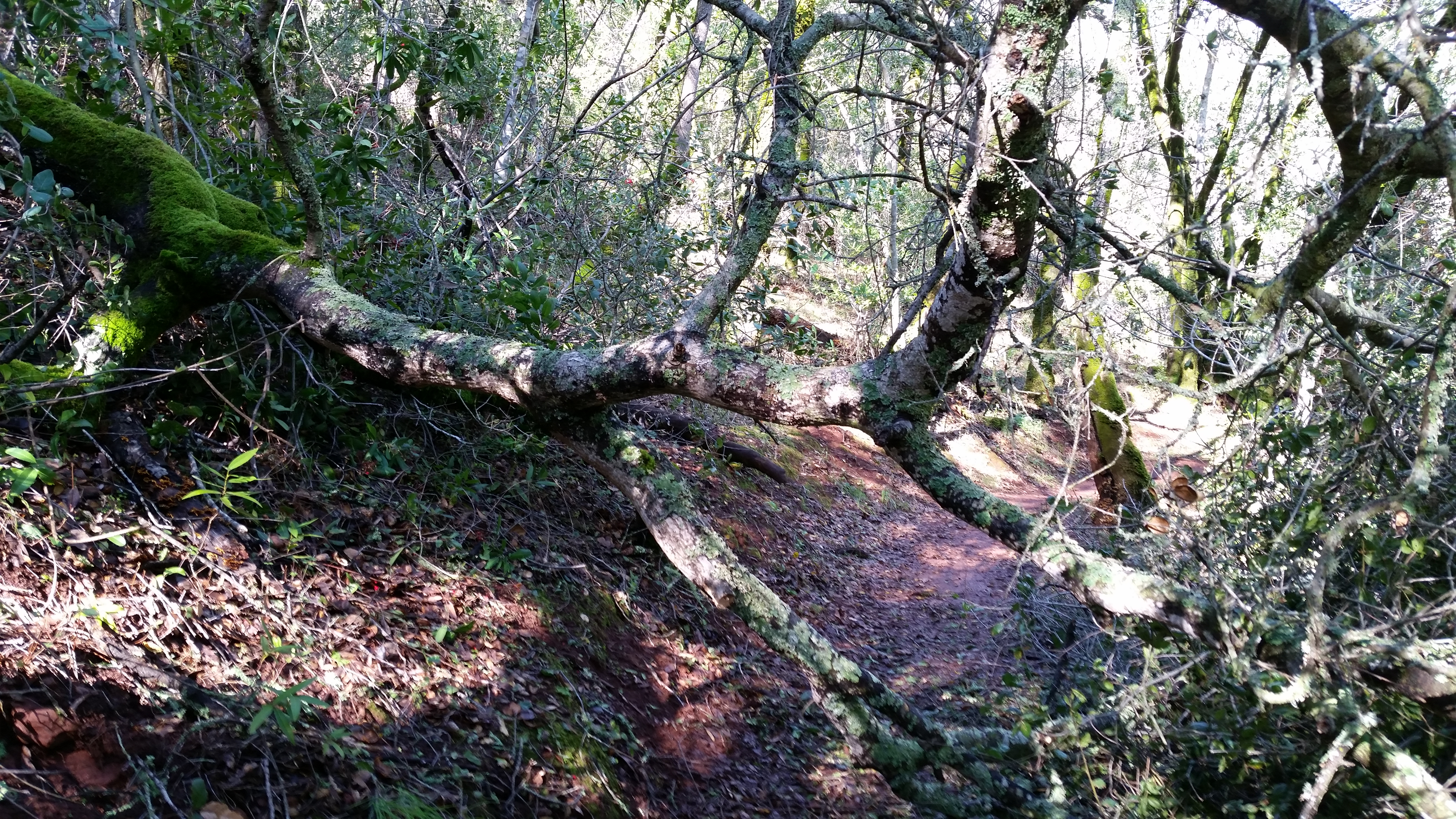

 Sonoma Overlook Trail • Montini Open Space Preserve