It’s a hearty group that gets out every Wednesday morning to hike the Overlook Trail. Who cares if it’s cold or rainy, the trail has it’s special beauty, and the deer seem to enjoy the company.


It’s a hearty group that gets out every Wednesday morning to hike the Overlook Trail. Who cares if it’s cold or rainy, the trail has it’s special beauty, and the deer seem to enjoy the company.
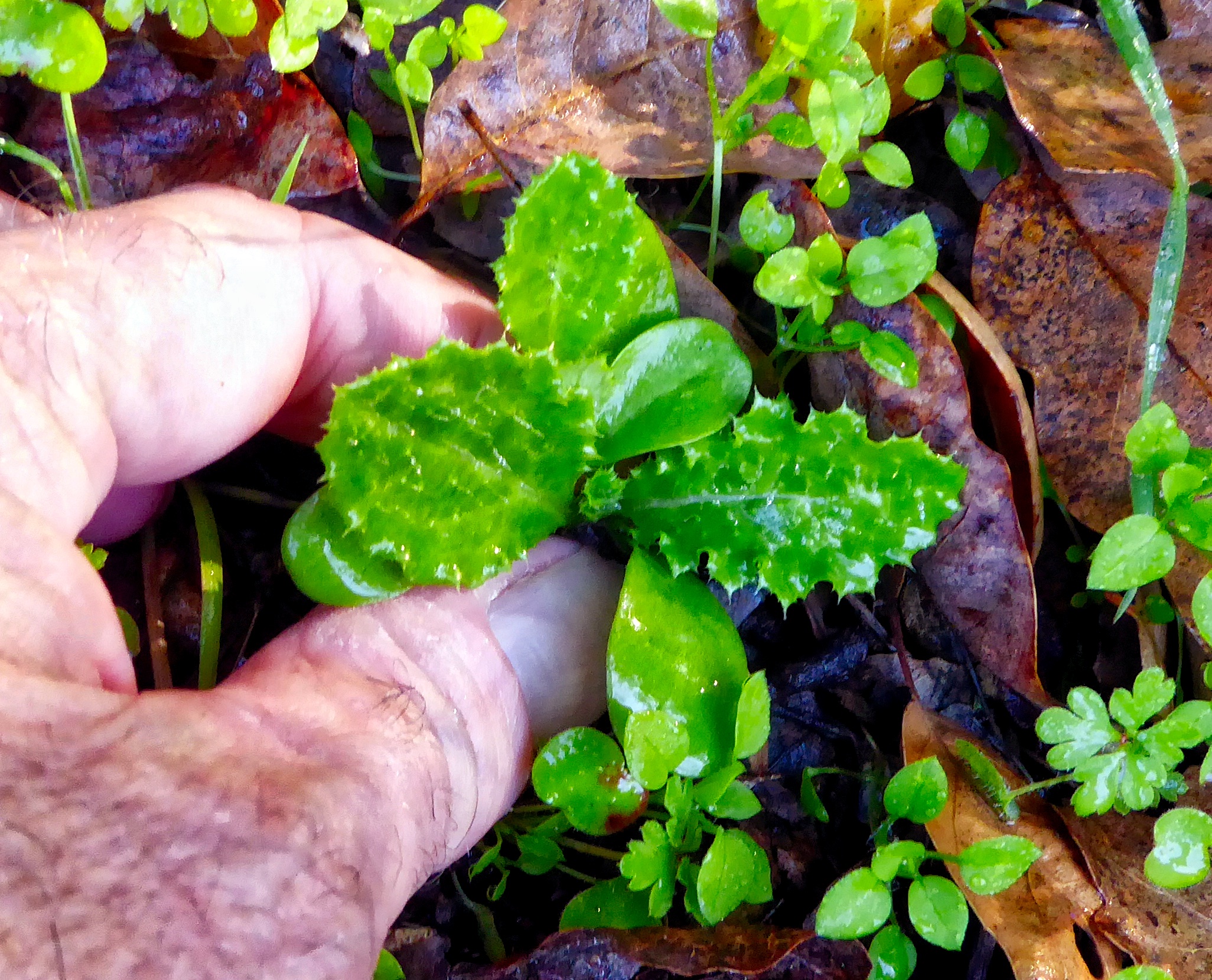
A young Italian thistle, which can grow to be over 6 feet tall.
Today I spotted the first Italian thistle plants (see picture) of the 2020 invasive species removal season — or what I simply call “thistle season,” as the species we’re most focused on at the moment are the Italian and Yellow star thistle. These species are fully capable of taking over entire ecosystems and driving out native species and even wildlife. Thus we fight.
Thistle season has grown to last from the end of December, with the early onset of Italian thistle (slightly later this year), to well into August with the Yellow star. That makes thistle season nearly 8 months long, with only 4 months off. It doesn’t mean that we’re out there every day, mostly hand-pulling the weeds, but it means that every day we can starts to add up to a real difference. As it is, we’re witnessing a decrease in the volume and extent of Yellow star thistle, since we’ve attacked it for close to a decade. It’s even gone from some areas. But Italian thistle has essentially overrun the Montini Preserve and it is threatening to do the same on the Overlook Trail property. Thus, our recent efforts on Italian thistle have tended to focus on the Overlook Trail — first to eradicate it from the trail verge, where traffic on the trail can spread it, and then to fight it back from the trail into the surrounding areas.
Last year we were successful in clearing it back from the trail, but much beyond that was mostly untouched except for a few select areas. This year we’re hoping to have the time to take the fight further out from the trail, and especially hit some meadows where it hasn’t yet become widely established, such as the Upper Meadow on the Overlook. But the season has just begun, so we shall have to see what we can accomplish this season.
Meanwhile, if volunteering to help us pull these weeds is something that might interest you, I recommend you first read this post: “‘Don’t Look Up’ and Other Lessons from Invasive Species Removal.” We’re not trying to scare you off, really we aren’t, but it’s best to approach this work with your eyes open. Trust me on that. If you’re still game, let me know.
If you don’t wish to volunteer, but see us doing the work when you hike, throw us a wave. Feelings of pity and “there, but for the grace of God…” are also appropriate.
August seems like a long, long way off from here.
 Please join us for a lively, informative walk through our historic Mountain Cemetery with amateur historian Fred Allebach. Meet cowboys and Indians, ranchers and real estate tycoons, farmers and farriers, carpenters and stone masons, quarry-men, grocers, butchers, bakers, maybe a candlestick maker, and many more!
There is a $35 fee to raise money for maintaining the Overlook Trail.
Saturday, November 2, 2019, sign up for one of two hikes: 10:00 AM or 12 Noon — SIGNUP
Add to Calendar
Meet at the Overlook Trail Kiosk
90 First Street West
Sonoma, CA 95476
Hope Nisson
Sonoma Overlook Trail
sonomaoverlooktrail@gmail.com
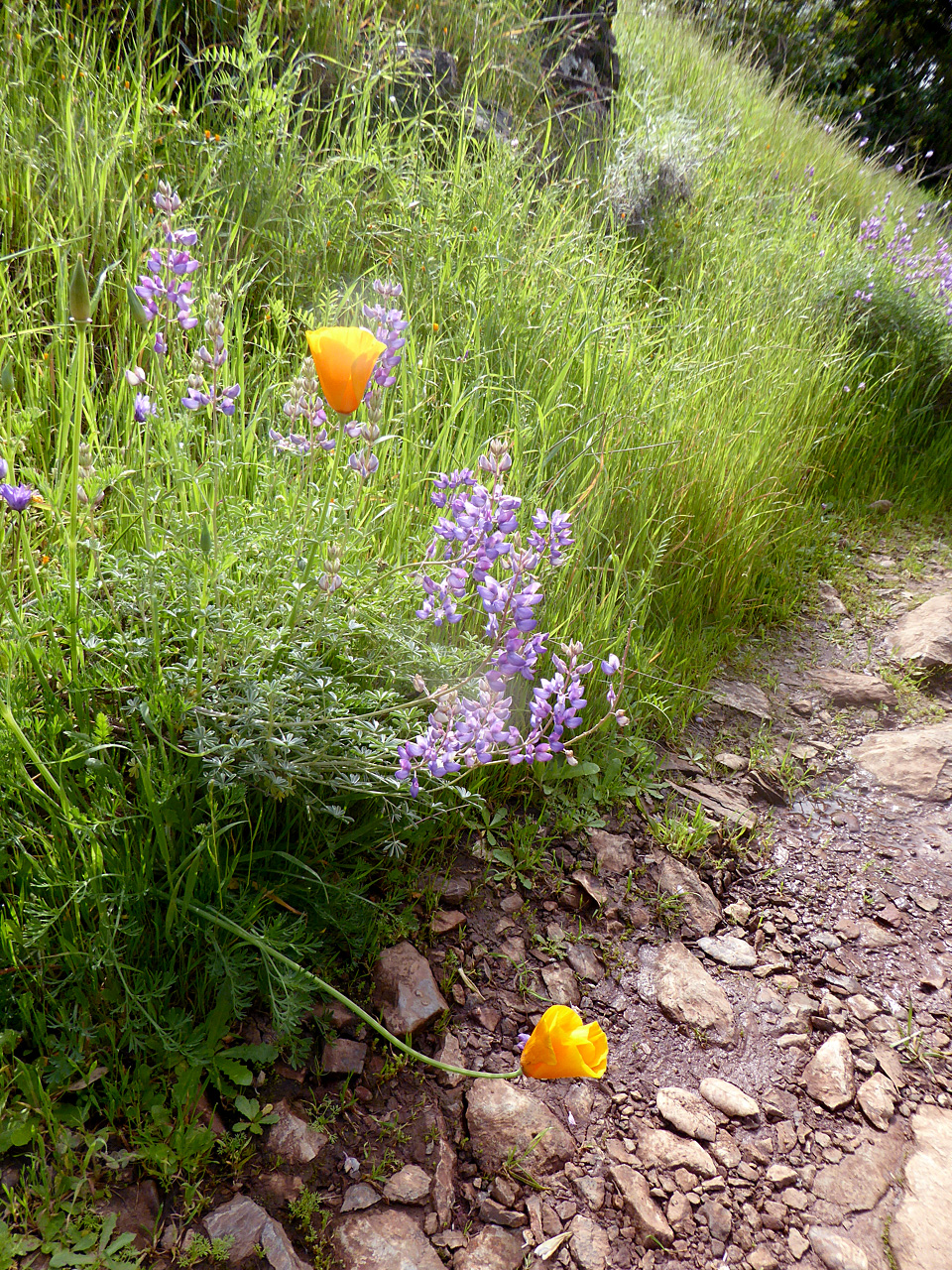 Spring is the season of renewal, which manifests itself out in the wild in a myriad of interesting and beautiful ways. Certainly the abundance of wildflowers is an obvious example of spring, but it’s by no means the only sign. In certain areas of the state, we were blessed with a “super bloom” of rather massive proportions that was truly something to see. Entire hillsides were painted with orange, or purple, or blue wildflowers. I was in the Merced River canyon just outside Yosemite in April and you could look up and see an entire hillside of California poppies. So…yeah, wildflowers are, I assert, one of the most beloved signs of spring.
But of course there are others.
Once the Western fence lizard makes an appearance, you know spring has sprung. These reptiles need warmth to be able to move around, so once the weather gets warmer they will be seen on the trail. They are definitely our friends in a particular way. “Studies have shown,” Wikipedia tells us, “Lyme disease is lower in areas where the lizards occur. When ticks carrying Lyme disease feed on these lizards’ blood (which they commonly do, especially around their ears), a protein in the lizard’s blood kills the bacterium in the tick that causes Lyme disease.” And since another sign of spring is the presence of ticks, the timing is fortunate.
 Other reptiles such as snakes are frequently spotted in spring, as they are out and about looking for a mate. Many mammals are as well. Just today on the Montini Preserve I saw a male wild turkey in full display, trying to attract a mate from a bevy of females (see picture, the females were out of the frame). A couple females were fighting, I presume over the right to go after this fine specimen. Oh how I wish females would fight over me, but then I’m not nearly as good looking as a turkey. Sigh…
 I saw a gopher snake the other day, draped right across the trail enjoying the sun. I took some pictures (see one to the right) and walked around it, leaving it undisturbed. I then told other hikers to look for it, secretly hoping it was still on the trail so they could see it. Seeing snakes on the trail is actually a rare occurrence, and should be viewed as an excellent opportunity to see a type of wildlife that one doesn’t see very often.
Rattlesnakes, which are of course more dangerous than the harmless gopher snake, have also been sighted this season. Spring is actually when snakes are most often spotted by hikers, and Richard Dale, Executive Director of the Sonoma Ecology Center has an idea why: “Now that the weather has warmed, adult Northern Pacific rattlesnakes, the only likely species in this area, are making their way out of their winter dens to mate, and males will be facing off to vie for females. Perhaps this is why in my experience they seem to be most visible this time of year, and they seem to be less so as the year progresses.” That has been my experience as well, nearly every rattlesnake I’ve ever had the delight to spot happened to be in Spring.
 Although rattlesnakes inspire fear in people (me included), it’s important to realize that snakebites are actually quite rare. Richard Dale says “55% of bites occur on men between ages of 17 and 27, and 85% of all bites occur on hands or the forearm…and 28% of bite victims are intoxicated. So it’s probably a good idea not to pick them up with your hands, especially while intoxicated. Not to make too light of them, they are dangerous, but common sense will very likely keep you safe.” That has also been my experience. I know of several incidents when I or another hiker was standing within striking distance of a rattlesnake and the snake did not strike, it warned with its rattle. Of course that causes most of us to jump wildly away from the sound, which is exactly what the snake wants. It doesn’t want to bite something so big that it has no hope of eating, it just wants some space, and most of us are only too happy to comply.
So if you happen to walk up on “Big Jo/e” (s/he, not sure which), who hangs out on the Montini Preserve (see photo), just give him/her a wide berth and go about your business, as will s/he. If you stick to the trail you really have nothing to worry about.
 Sonoma Overlook Trail • Montini Open Space Preserve