The Park Blessings of This Valley

If you are putting up with my ramblings on this blog, you clearly love the Sonoma Overlook Trail and Montini Preserve enough that you are a true nature lover. Like me.

So like me, you are probably amazed at the embarrassment of open space riches that are ours here in the Sonoma Valley. Starting from the Bay and going north, here are a number of our choices (and amazingly, not all of them by any means):

From top to bottom the southernmost park is only 45 minutes away from the northernmost. This means that most people who live in Sonoma Valley (some 11,000+ people) are only about 20 minutes away, or much less, from all of these open spaces. Truly an amazing array of opportunities for exploring the outdoors, from baylands, to mountains well over 2,000 feet.

Not long ago my wife and I visited the Willamette Valley in Oregon, to taste their storied Pinot Noir wines. One morning we wanted to find a place to hike, and barely found even one place to do it. We are truly blessed here in Sonoma Valley, with so many options for outdoor recreation. I call the outdoors my “spin class,” as you will never find me in a gym. Give me the outdoors. Ever the outdoors. I will see you there.


Trail Rehabilition Star Volunteer

Mary Nesbitt was honored today as a “Star Volunteer” at the Sonoma Valley Fund’s Annual Celebration of Volunteers. Mary was vital for the Trail Rehabilitation Project (starting summer 2018), securing $80,000 in project funding by identifying appropriate sources and writing grant proposals. She also has designed communications to inform the public, and has been a key player in meetings with the City of Sonoma and interested parties. She is part of the Sonoma Overlook Stewards, an all–volunteer organization that is dedicated to maintaining the Overlook Trail and providing educational opportunities for children and adults in Sonoma Valley.

Thank you Mary, for all you do for our beloved trail.

IMG_4445

Jeni NIchols, Mary Nesbitt, and Joanna Kemper

Watch Out For Ticks!

Yesterday I pulled a tiny tick off me (see photo), sadly not before it had bitten. Now I have a sore and swollen red spot on my back, and I’m on the lookout for any signs of Lyme disease. That is a serious disease that needs to be caught early to have any chance of avoiding potentially serious consequences.

A study in the 1990s found that the Western Fence lizard, which is plentiful on both the Overlook and Montini properties, has an enzyme that can essentially cure a tick of transmitting Lyme disease. However, a study in 2008 found that after removing the Western Fence lizard population from a plot of land, the number of ticks went down as well, as most of the young ticks could not find another host. So although the later study did not negate the findings of the earlier one, it does point out the complexity of the interactions of various populations and these effects on the spread of disease.

All of that is perhaps just a long-winded way of saying — be careful! Check yourself and others after hiking on the trails. Believe me, you don’t want to be me.

The March/April Miracle

Perhaps we could be forgiven, those of us here in Northern California, for believing that we were heading right back into drought. The amount of rain we had received through February (typically some of our heaviest precipitation months) was truly sad. But then March came, and brought more rain, and even more important, snow in the Sierra Nevada Mountains.

And then came April, which has brought a Pineapple Express storm, with reportedly more to come. Today on the trail we saw a phenomenon we only see when the runoff is truly epic — popup springs (see picture). This happens when water completely saturates the soil and finds underground channels. These channels then surface in random spots in the hillsides, spilling out to run down the hill before finding a creek to add its volume to, potentially leading to flooding downstream.

Logically, I know that this can lead to tragic consequences. But upstream, where these popup springs happen, it simply seems exciting. This is one of the reasons why I love to hike in the rain. I never let the weather stop me from hiking the trail. I put on my rain pants, parka, and waterproof shoes, and go for it. It can be an astonishing time. One day I saw a flock of turkeys running through a downpour. Several other times the creek on the Overlook was running so high I had to hike upstream to find a place to cross it. But it never fails to be exciting, at least to me.

Come enjoy the miracle, as I do. In the glorious wet. It’s only water, after all, and what you stand to gain is a lot more impactful than that.

There’s Never Just One

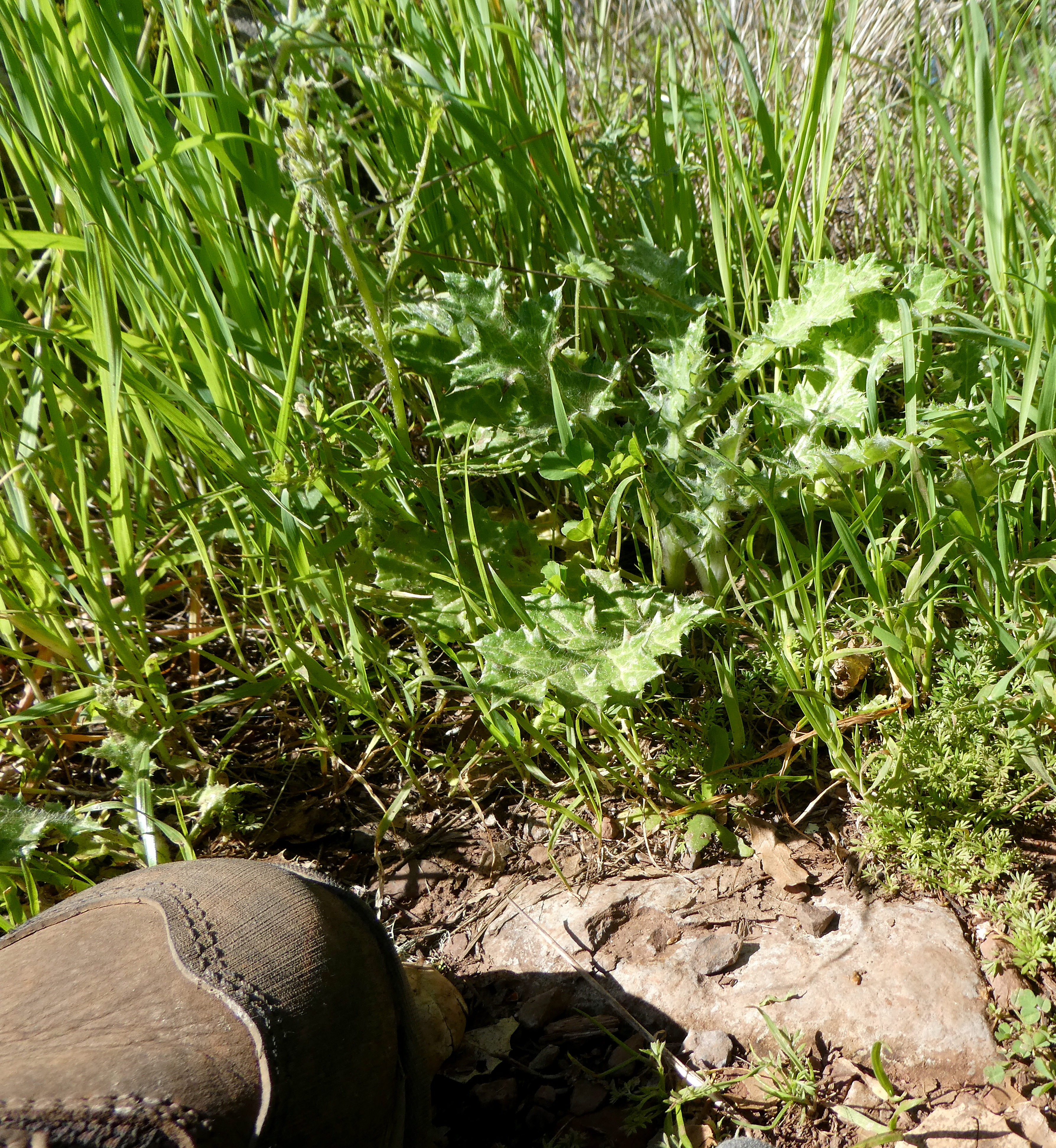
Tripping down the trail today I thought to myself, “Oh, hey, there’s one!” I had spotted an invasive purple thistle plant at the trail’s edge (see pic). I stooped to pull it out.

As volunteer trail stewards, our remit includes not only maintaining the trails, but also helping the City of Sonoma to maintain their property that the trails traverse. This includes removing invasive species such as broom, purple thistle, and yellow  star thistle.

Purple thistle season begins in early Spring, which means we are already working to remove it. Later in the season the yellow star thistle will start to come in. Since we’ve been attacking the yellow star thistle for several years with vigor, we are seeing some real progress on eradicating it from the Overlook and Montini Preserve properties.

However, purple thistle is quite another story. Mostly due to years of cattle grazing, purple thistle has essentially already overrun the Montini Preserve. So at this point we only focus on yellow star thistle there. But on the Overlook, we think we have a chance to knock back the purple thistle so we are working on it as well. Since we only began our work on it last year, there is still quite a bit of it on the trail.

Today, as I stooped to pull the plant I had spotted I thought to myself, “Oh, wait, there’s five — no ten, crap, there’s a lot!”

I had momentarily forgotten that until the day when we reach the point of eradication — years, perhaps even decades from now (if ever), there’s never just one.