Cemetery Walk November 3rd

DIA DE LOS MUERTOS — DAY OF THE DEAD

WALK SONOMA HISTORY THROUGH SONOMA MOUNTAIN CEMETERY

Saturday November 3

10:00 AM OR 12:00 Noon

The Sonoma Overlook Trail Stewards invite you to take a lively, informative walk through our historic cemetery with amateur historian Fred Allebach.

Meet cowboys and Indians, ranchers and real estate tycoons, farmers and farriers, carpenters and stone masons, quarrymen, grocers, butchers, bakers, maybe a candlestick maker, and many more!

Here in our back yard, the fabric of the town’s rich history is hidden right in plain sight,” tour guide Allebach has written about the historic cemetery.  “Sonoma had its Natives, then missionaries, Spanish, Mexican, and Anglo Californios, Gold Rush and Manifest Destiny immigrants, Civil War refugees, and a Second Great Wave of Immigration from southern and eastern Europe from 1880 to 1910. Then came various immigrants on into the 20th century. All of these are represented in the Mountain Cemetery.”

Your $35 donation includes the walking tour and cookies and cider. All proceeds go to maintaining the Overlook Trailhead Kiosk. The Trail is solely supported by private donations. Questions? email Hope at hopenisson@me.com.

To Register: send a check to Hope Nisson, 3771 Cory Lane, Sonoma, CA 95476. Indicate which hike you prefer — 10 am or 12 noon

The event is sponsored by the volunteer Sonoma Overlook Trail Stewards and participation is limited to 20 people per session.


More Rehabilitation Progress

The Sonoma Overlook Trail rehabilitation work has been coming along, and we are now over 50% complete. There is more information and photos of the work at the City of Sonoma’s web site.

Sonoma Overlook Trail to Close June 17 for 14 Weeks

On June 17th The Sonoma Overlook Trail will be closed for a re-routing and rehabilitation project. More information is on the City of Sonoma’s web site, including alternative places to hike (the Montini Trails chief among them).

Being Gently Powerful

You could say that I’m a treehouse nut, as I’ve never understood why most people think that treehouses are for kids. The fourth one I’ve built, is in my backyard — a three story monstrosity that tops out at 32 feet above the ground. In the “crows nest” at the top, you can see over our house and down across Sonoma Valley to Sonoma Mountain, and south down the valley toward Marin. The lower parts of the treehouse were built 13 years ago and the upper parts 10 years ago. Both are slowly being absorbed and warped in odd ways by the tree.

In one spot (pictured), the ladder leading to the crows nest has been slowly bent way out of its straight up and down position. Clearly if it had been warped that badly all at once, it would have shattered. But rather, the tree gently but persistently pushed against it, and it has slowly but surely stretched it into its present position. It is this aspect of “being gently powerful” that one sees a lot in nature. Trees can also break stone using the same technique of very slow but persistent pressure.

In a related example, on a river trip through the Grand Canyon you eventually come to a section deep in the canyon where the oldest rock is exposed. It is a very hard, metamorphosed volcanic granite and schist. And yet the Colorado River has not only carved it’s path through the very heart of it, it has actually sculpted it, with intricate and fascinating incisions (see photograph). These were formed not by one cataclysmic event, but by the very slow and constant caressing of suspended silt and sand by the river over eons. The river is being gently powerful over a very long period of time.

I’ve come to believe that is exactly what our efforts to clear the Overlook and Montini Preserve of invasive species needs to be like. We need to be gently powerful for many years. As I said to someone on the trail recently, “this is a program, not a project.” You could also call it a war, not a battle. But that’s a more violent image that I prefer to avoid. I prefer the idea of being gently powerful, as that is more like what it feels like.

Each day that I can get out on the trail during thistle pulling season I am blessed to experience the outdoors, feel the sunshine, sweat like crazy, and do something that I feel is meaningful. That feels like being gently powerful. And something that feels worthy in and of itself.

So the next time you see one of us out there pulling invasive species, think of us as a tree or a river — gently, but powerfully and persistently, pressing against what we oppose. It, too, will give over time, as all things that are gently, powerfully, and persistently opposed eventually do.


Vishnu schist photo by Al_HikesAZ, Creative Commons License CC BY-NC 2.0.

There’s Never Just One

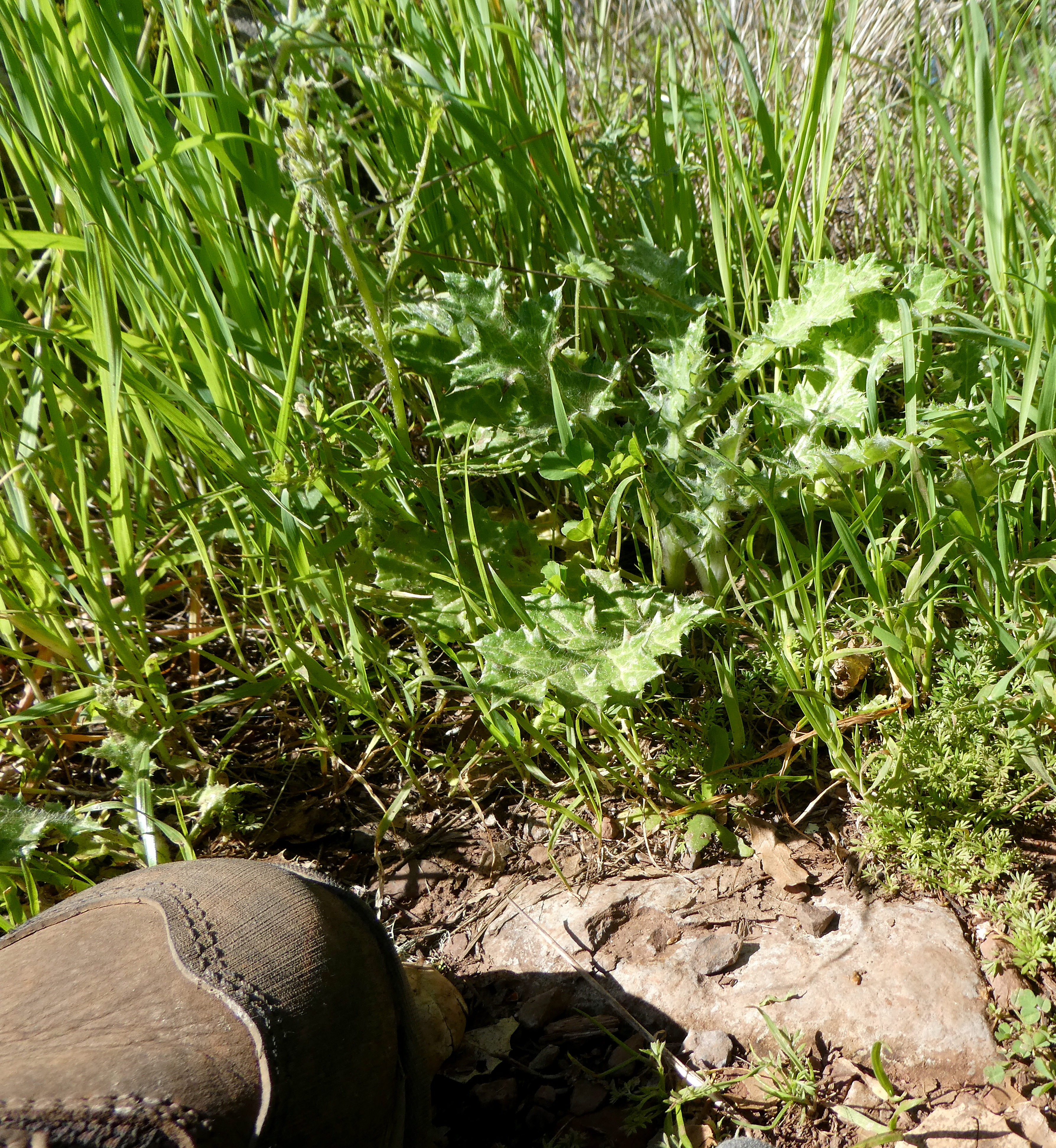
Tripping down the trail today I thought to myself, “Oh, hey, there’s one!” I had spotted an invasive purple thistle plant at the trail’s edge (see pic). I stooped to pull it out.

As volunteer trail stewards, our remit includes not only maintaining the trails, but also helping the City of Sonoma to maintain their property that the trails traverse. This includes removing invasive species such as broom, purple thistle, and yellow  star thistle.

Purple thistle season begins in early Spring, which means we are already working to remove it. Later in the season the yellow star thistle will start to come in. Since we’ve been attacking the yellow star thistle for several years with vigor, we are seeing some real progress on eradicating it from the Overlook and Montini Preserve properties.

However, purple thistle is quite another story. Mostly due to years of cattle grazing, purple thistle has essentially already overrun the Montini Preserve. So at this point we only focus on yellow star thistle there. But on the Overlook, we think we have a chance to knock back the purple thistle so we are working on it as well. Since we only began our work on it last year, there is still quite a bit of it on the trail.

Today, as I stooped to pull the plant I had spotted I thought to myself, “Oh, wait, there’s five — no ten, crap, there’s a lot!”

I had momentarily forgotten that until the day when we reach the point of eradication — years, perhaps even decades from now (if ever), there’s never just one.