An interview with Overlook Steward Jackie Steuer

Jackie Steuer has been serving Sonoma Overlook Trail as a Stewards and much more for about 25 years, since its conception. Enjoy this chat between Jackie and Overlook Chair Jess about Jackie’s continuing experience with the Overlook and her background in environmental science, which includes years of service at Yosemite National Park.

Sonoma Overlook Trail
Welcome, Jackie!  I appreciate your taking the time today to share your history with the Overlook Trail.

The oldest picture I’ve seen of you was taken on the Overlook kiosk groundbreaking day.  Your daughter was there!

SOT Kiosk Groundbreaking

Jackie
Yes, she was!  Thank you for having me.

Sonoma Overlook Trail
Please spell her name for me.

Jackie
So it’s two words: Qing Chen. It means “early morning.” The Q is pronounced “ch”, so it sounds like Ching Chen.

Sonoma Overlook Trail
The other interesting thing I noticed is your Facebook profile, which talks about the fact that you worked at Yosemite, that you went to Berkeley, and you earned your degree in environmental biology.

Continue reading

Winter Birds on Sonoma Overlook Trail

ruby-crowned kinglet

Ruby-crowned kinglet

Winter on Sonoma Overlook Trail brings a quiet beauty, and with it a lively cast of birds that thrive in the cooler, wetter season. As deciduous trees lose their leaves, birds become easier to spot, flitting through oak woodlands, chaparral, and open grasslands.

Who’s over there? Such a restless little bird! A Bewick’s wren, barely five inches long, keeps darting about, looking for tasty insects. Scritch, scraaatch…SQUEAK! And what is that? A male Anna’s hummingbird with its raspy call. When it makes a sharp dive, air passing over its tail feathers creates the loud squeak. Its crown and throat are brilliant, iridescent red. Look for this fellow at the ends of bare branches. How is that woodpecker walking vertically up a tree? It has two toes facing forward, and two facing backwards to keep it from falling backwards. This little “ladder-backed” woodpecker, a Nuttall’s, is just seven inches long. It forages for insects as it circles tree trunks and branches.

Dark-eyed junco

Dark-eyed junco

Resident birds remain active year-round, relying on familiar territories to survive the colder months. Dark-eyed juncos and California towhees hop among the leaf litter at the trail’s edge, while Ruby-crowned kinglets and Oak titmice flit among leafless branches, searching for insects.

A Toyon shrub, also known as California Holly, full of red berries is an ideal stop for a flock of Cedar waxwings. When other fruit is scarce, the Toyon feeds these beautiful birds. As one nears the Upper Loop, the open skyline reveals Red-tailed hawks and Turkey vultures soaring over our rolling hills. Turkey vultures are nature’s garbage collectors–they eat carrion so it doesn’t sit around too long.

Cedar waxwing

Cedar waxwing

Winter birds play a vital role in Sonoma’s ecosystems, dispersing seeds and controlling insects. They also bring joy to winter hikers.

by Jaqueline Steuer, Sonoma Overlook Trail Steward
Photos: Unsplash

After the Fire, a Renaissance

Prescribed burn on Montini

The burn begins

If you visited Montini Open Space Preserve, our sister trail system, last summer, you’ll have seen the rather shocking, charred landscape resulting from the 20-acre prescribed burn that took place in the central meadow and surrounding forests to reduce wildfire fuel loads and risk for Sonoma and its neighborhoods, manage invasive species, and support other long-term ecological goals for the preserve.  The project was a collaboration of Sonoma Valley Fire District, in partnership with the City of Sonoma, Sonoma Ecology Center, CAL FIRE, and other agencies.  The Overlook was assessed for a burn as well, but as our layout is less accessible to water, one has not been prescribed.

Months later, as expected, Montini is well on its path to renewal.  Richard Dale, Director of Sonoma Ecology Center, offered his assessment and encouragement as the recovery process unfolded:

After the burn

A moonscape of charred earth

“I see significant recovery happening, as we’ve seen even after uncontrolled wildfire, especially in places like Montini where the fire was (intentionally) cool and mostly stayed on the ground.  Many of the trees I thought were damaged appear to be fine, with new growth happening in the upper canopy, and likewise things are recovering on the ground with native shrubs and grasses sprouting.  Other plants that need fire to keep them from dominating the landscape, like bay, have been reduced somewhat as intended.  I also see many kinds of birds, deer, ground squirrels, and other tracks around the burned area–sometimes using it preferentially–far more than I would have expected.

Montini Open Space Preserve

Late fall 2025 on the burn site

As for pile burns vs fire on the ground, as you likely know, cultural or human-assisted fire has been part of local landscapes for millennia, so much so that local landscapes evolved with them, and recent fire suppression has caused major ecological issues: crowded stands of even aged trees that are less healthy and actually store less carbon, more invasive plants, decreased overall diversity, less food for wildlife, higher severe wildfire risk, and so on.  There are significant benefits to pile burning, as was done throughout the preserve over the last few years to prepare for the burn that happened in June, and, there are even more benefits from burning.

Native Grass Renewal

Native grass renewal

The main issue we had with the burn is that it would have been better carried out in the fall so that the period before the wet season would be shorter. This seems appropriate for a place that is used for recreation by people, and it might reduce plant stress from prolonged exposure to higher temperatures caused by sun on the darker ground all summer. Still, local fire agencies and CalFire offered a lot of support for an early burn, because it helps them train their staff, and they have staff available early in the season before they are deployed around the state on wildfires. It also allowed us to target an especially aggressive non-native grass, Medusahead, that is best controlled with earlier burns.

On the whole, I think it will prove better for vegetation, and perhaps even for visitors once the burn area has had more time to recover, and less crowded and larger, healthier trees have established.”

We welcome you back to Montini, where nature continues to triumph, as she does.

Our Year-End Appeal: Help us keep Sonoma Overlook Trail healthy and accessible!

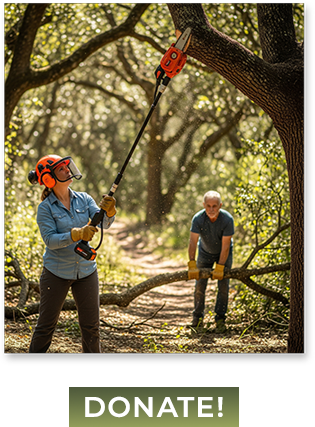
The all-volunteer Sonoma Overlook Trail Stewards need your tax-deductible support to continue our work.  Please keep us in your thoughts as you make your year-end donations this giving season!

We receive over 60,000 visits a year, making us, in a sense, the largest nonprofit in Sonoma!  All of this impact wears on the trail and surrounding trail corridor.  Every dollar we receive goes directly to the care of the Overlook.

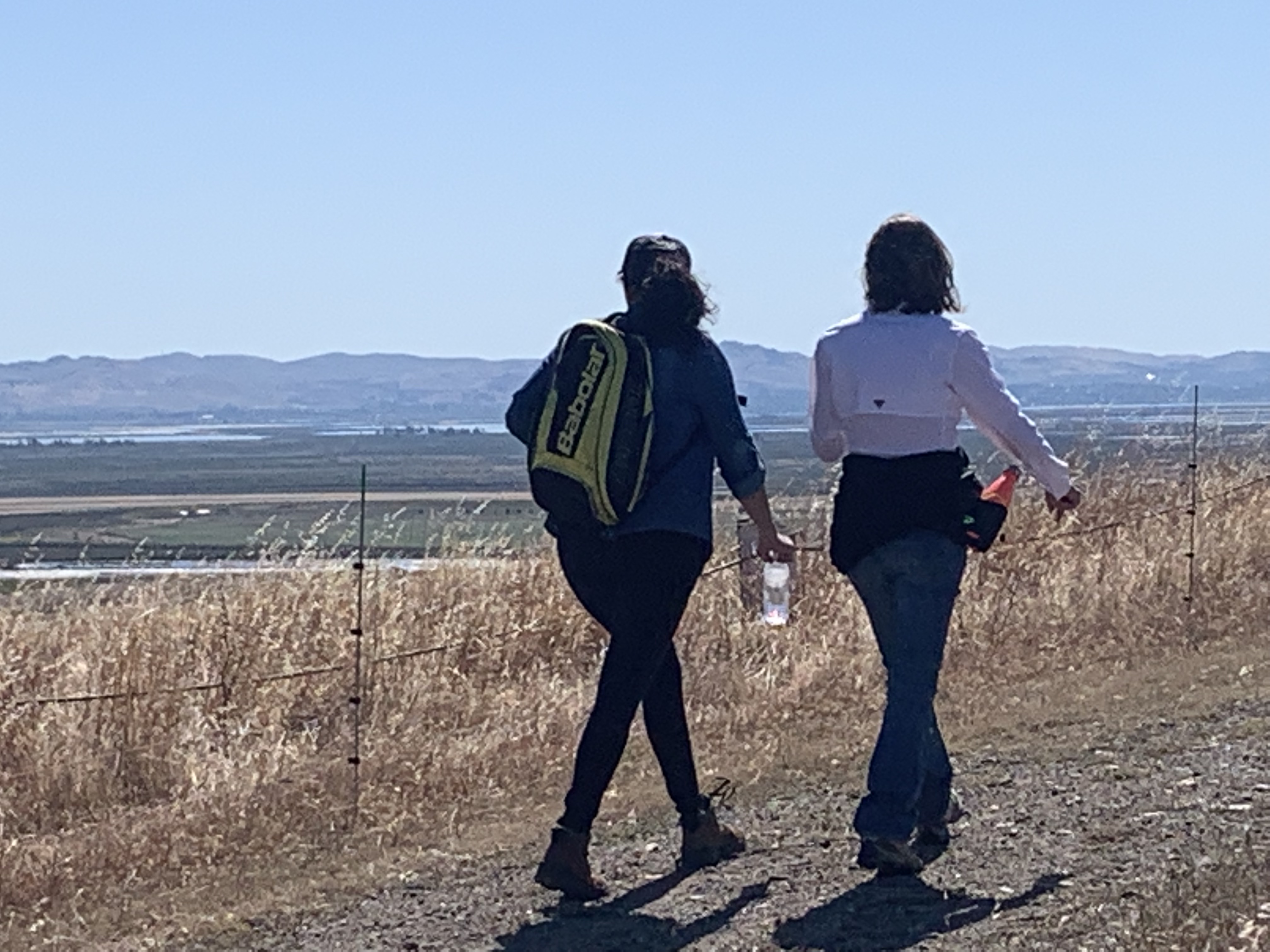
We each have our reasons for visiting the Overlook Trail.  Some come to see the trees, the wildflowers, hawks, turkeys and deer, or to watch their kids catch (and release!) a lizard.  For some, it’s about elevation gain, heart rate and calorie burn.  The Overlook can be a social stroll, or a place to talk things through up at the Meadow Loop as you sweep your eyes down the Valley and out to sea.  And, especially these days, it’s a sanctuary, an escape from the facets of life that wear on us.

Our ongoing work to keep the Overlook in shape requires investment in tools and other supplies, outreach materials, and sometimes the help of specialized crews to undertake the heavier, more technical endeavors that shape our sometimes-rocky trail into a condition that allows more to enjoy it.

This essential Sonoma paradise—and all who find connection in it—relies on you.  So we ask: If you are inspired to contribute to the tending of this special place, please make a tax-deductible donation to the cause.

  • Make your check payable to “Sonoma Overlook Trail” and mail to:

Sonoma Overlook Trail
P.O. Box 431
Sonoma, CA 95476

Thank you kindly in advance–come visit us on the trail!

Affectionately,
Sonoma Overlook Trail Stewards

Forest Mystic: Wild Mushrooms on the Overlook Trail

The Overlook Trail abounds with wild mushrooms! Take your own visual treasure hunt; they’re everywhere…. But of course, as with everything on our trail systems and wild areas, leave them undisturbed. Mushrooms can be deadly if consumed.

Wild Mushrooms

Continue reading