Our Commemorative Book is Out!

us-letter-hard-cover smallAs part of our upcoming 20th Anniversary of the trail celebration, we decided to publish a book based on the entries that hikers have left in the notebooks that we have left on the bench at the top of the trail since the very beginning. That book is now out and available for purchase. The View from Above: Thoughts and Art by Sonoma Overlook Trail Hikers is a lovely 8 1/2″ x 11″ full-color coffee table book with photographs of both journal entries hikers have left and gorgeous trail photos.

Journal entries have been organized into chapters based on their essential message. Here are just some examples:

  • Appreciation
  • Gratitude
  • Love
  • Loss, Heartbreak, and Uncertainty
  • Philosophy
  • Advice
  • Determination
  • Encouragement
  • etc.

We also provide “interludes” of art, humor, poetry, and other entries that hikers have left in the notebooks.

At the beginning of the book we have written a short history of the trail property through the years and how the trail came to be (it was born in the midst of controversy). At the end we list all of the extant notebooks and all of the locations from around the world where our hikers call home (nearly all 50 states, several territories, and many countries).

We are selling it for $30, plus $2.70 sales tax, and for non-Sonoma Valley addresses, and additional $7.00 for shipping. You can make a check out to Roy Tennant and send it to 1212 Alberca Rd, Sonoma, CA 95476. We can also accept Venmo payments @Roy-Tennant.

Controlling Water on the Trails

The Trail Maintenance Team for the Sonoma Overlook Trail does a variety of tasks, but one of the most important things we do is manage the flow of water across the trails. Essentially, what we try to do is to move the water off the trail as soon as it comes on. The best way that this happens is in sheet flow from the upper side of the trail to the lower side, but that is rarely the situation we can accomplish.

One challenge is that water often comes onto the trail not in a gentle sheeting flow, but in what is essentially a tiny creek. Another is that it isn’t always an option to have the water sheet off the downhill side. We often need to allow it to flow down part of the trail before directing it off in a waterbar (a channel we cut in the trail to force the water off the trail).

There are also other structures we build to manage water. Perhaps chief among them is the armored swale. An armored swale is essentially a deep channel you cut in the trail that you “armor” with rocks so it doesn’t erode as the water flows over it and off the trail. Another strategy we use to encourage sheet flow off the trail is cut the “berm” or the very edge of the trail that can build up in a way that keeps water on the trail instead of allowing it to sheet flow off of it.

All of these structures require ongoing maintenance, and the more subtle structures require more maintenance than the more dramatic ones.

Over the last few days (one of them during the recent rainstorm) I was out renewing the structures in place and cutting berm to better enable water flow off the trail. I also deepened a few waterbars and performed other tasks to better channel water from the trail.  I will again be out there tomorrow afternoon during the rainstorm with a shovel, to see what needs fixing. It’s part of what we stewards do.

Look who’s hiking and working on the trail

Every Wednesday morning at 8:30 a group of hikers gather to hike the Overlook.

Up (30 minutes), then the Top (catch breath and take photo) and then down (30 minutes). Here’s a few photos from the top by the bench from this past year of Wednesday hikes.

And look who we bump into on the trail nearly every week. Hint–he’s going from rock removal to invasive removal –see his blog posts!

Join us at the Trailhead kiosk on Wednesdays. . . the hike is open to the public. Good way to start the day. . . and enjoy the view from the top!

The Game is Afoot

Picture of an Italian thistle plant.

A young Italian thistle.

I know what all five of you who read this blog are thinking: “Oh no, not again!” you’re groaning. And I don’t blame you.

Yet again I’m blogging about invasive species management on the Overlook and Montini properties, as I have for years. But as you might imagine, there’s a reason for that, and it’s because we’re in a decades-long fight that we may never win.  So buckle up, buttercup, here we go again!

I first sighted Italian thistle popping up in early November. Certainly by November 8, two days earlier than last year, I noticed more than one patch of it. Therefore, today I went out on the Montini Preserve and pulled not only the one pictured plant (the largest one I found today), but also many other, much smaller plants. The game is definitely already afoot, thanks to some early rains.

So far I’ve been unable to tell if our previous work has made much of an impact on the problem. My instinct is that we haven’t yet, that we still have a ways to go to seriously reduce the seed bank present in the soil. There seem to be plenty of plants along the trail on the Montini, which is where I’ve focused much of my attention, so there doesn’t seem to be much progress there. Yet.

But if there’s one thing I know, it’s that invasive species management is a long game. And few people know what the long game takes better than I do, I submit. So once again I saddle up, and enter the fray. I’ll see you out there.

Rock Patrol Ups Its Game

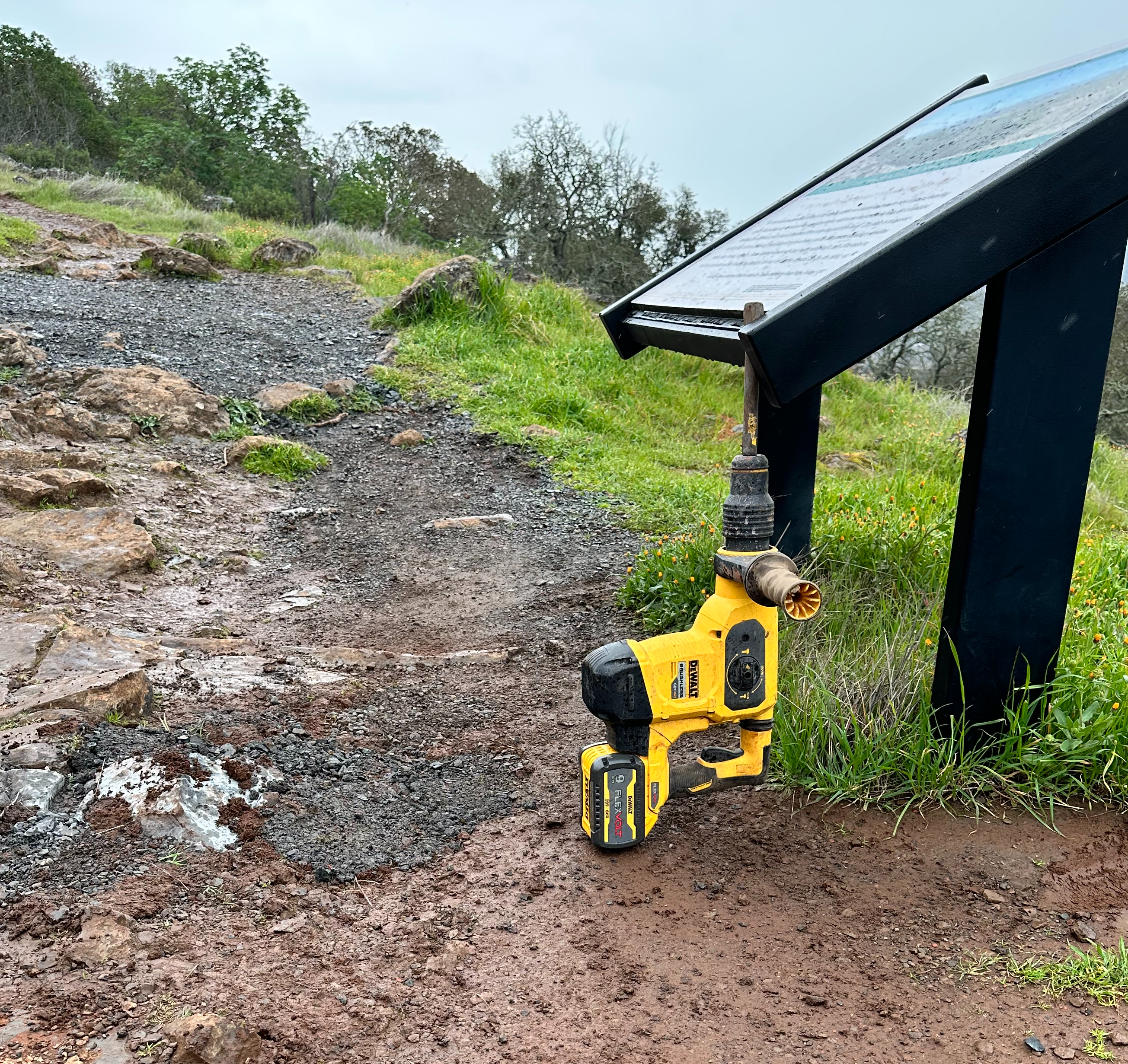
rock chiselAfter I became Maintenance Chair, I began considering new kinds of trail maintenance activities. Since Sonoma Overlook Trail is a particularly rocky trail, over the past year or so I pioneered what I dubbed “Rock Patrol“. As it was originally conceived, it consisted of hiking the trail with a shovel and a pry bar, levering out rocks and backfilling with soil to remove “trip rocks” and make a smoother tread.

Over time, I added an activity that I called “trail smoothing”, which I conceived of as a more systematic effort over a stretch of trail from 6-12 feet or more. In this activity, we would remove many rocks from the trail bed and fill with soil and gravel, packing it down to recreate a smooth tread. This was devised as an activity for our monthly group trail maintenance work days.

Now I’ve added another activity that I’m calling “rock reduction”. To do this, we’ve purchased a cordless rock chisel/hammer/drill (pictured; click the photo to see a video of it in action). As I say in the video, it is a complete game-changer. I really don’t think there is a rock on the trail that we can’t now either completely remove or reduce to trail level or below.

Given that fact, I’m now open for any trail hiker or runner’s nominations of rocks to remove or reduce. Take a photo of your most hated rock and/or ridge of bedrock that impinges on the trail and send it to me at roytennant@gmail.com along with a description of where to find it on the trail. Just do your best; I’m pretty sure I will recognize it. Having nominated it, I will let you know when it has been removed or reduced.

Check out the video. It’s less than 2 1/2 minutes long and I think it does a great job of illustrating how we can now take down even some of the hardest rocks on the trail (many are much softer than the one in the video, which I had originally attempted to take out using a large, heavy, iron pry bar).

Rock reduction is now officially part of our arsenal.