Lizards are Back!

lizardToday was the first day I noticed lizards on the trail this year, although it must be admitted that I hadn’t been on the trail for a couple days. But suddenly they are everywhere, along my entire hike from the 4th Street trailhead on the Montini Preserve all the way up to the top of the Overlook. Lizards provide a characteristic short, sharp rustling sound as they scurry and stop, scurry and stop, in the dry leaves. If the rustle is not of this variety, it may be a snake instead.

Lizards, like snakes, are reptiles and as such are cold-blooded. This means they rely upon their environment for body heat, which also requires them to hibernate for a period during the winter when ambient temperatures are cold. When they emerge from hibernation depends on the weather, and our recent heat wave in mid-February clearly has released them from hibernation.

So keep an eye peeled for this little creatures, who are often quite colorful, and also for their cousins, snakes. If the lizards are out, then rattlesnakes can’t be far behind.


The Role of Prey

remainsIn a recent post, I wrote about the role of raptors and other predators. The animals that predators prey upon are also of very important for a healthy ecosystem. It’s also worth pointing out that predators can also be (and often are) prey themselves.

In that prior post, I referred to the now classic case of  ecosystem failure caused through over-hunting predators on the Kaibab Plateau in Arizona. The deer, freed from predation by their natural predators, soon over-populated the area and over-grazed the land. Their impact led to an ecosystem that could support fewer of both prey and predators. So having a balance is important, and human intervention can often lead to tragic consequences.

10995414_10152560511126786_773420903753463030_nTherefore, when I run into the remains of various animals on the trail, I am less dismayed at the fallen animal than I am grateful for their existence and what they contributed to a healthy ecosystem. We need prey. We need predators. We need predators to also, in most cases, be prey as well. It may be that we are the first predator and prey that has largely escaped one of these roles, except, it must be pointed out, from ourselves.

In the end, humans are the most deadly predator of them all.

Wild Turkeys Couldn’t Drag Me Away

An adult wild turkey in the Red Quarry.

An adult wild turkey in the Red Quarry.

“Wild horses couldn’t drag me away” – Mick Jagger, Keith Richards

I think I’m beginning a rather disturbing habit of quoting song lyrics and lines from movies in these posts. Slap me if I get out of hand.

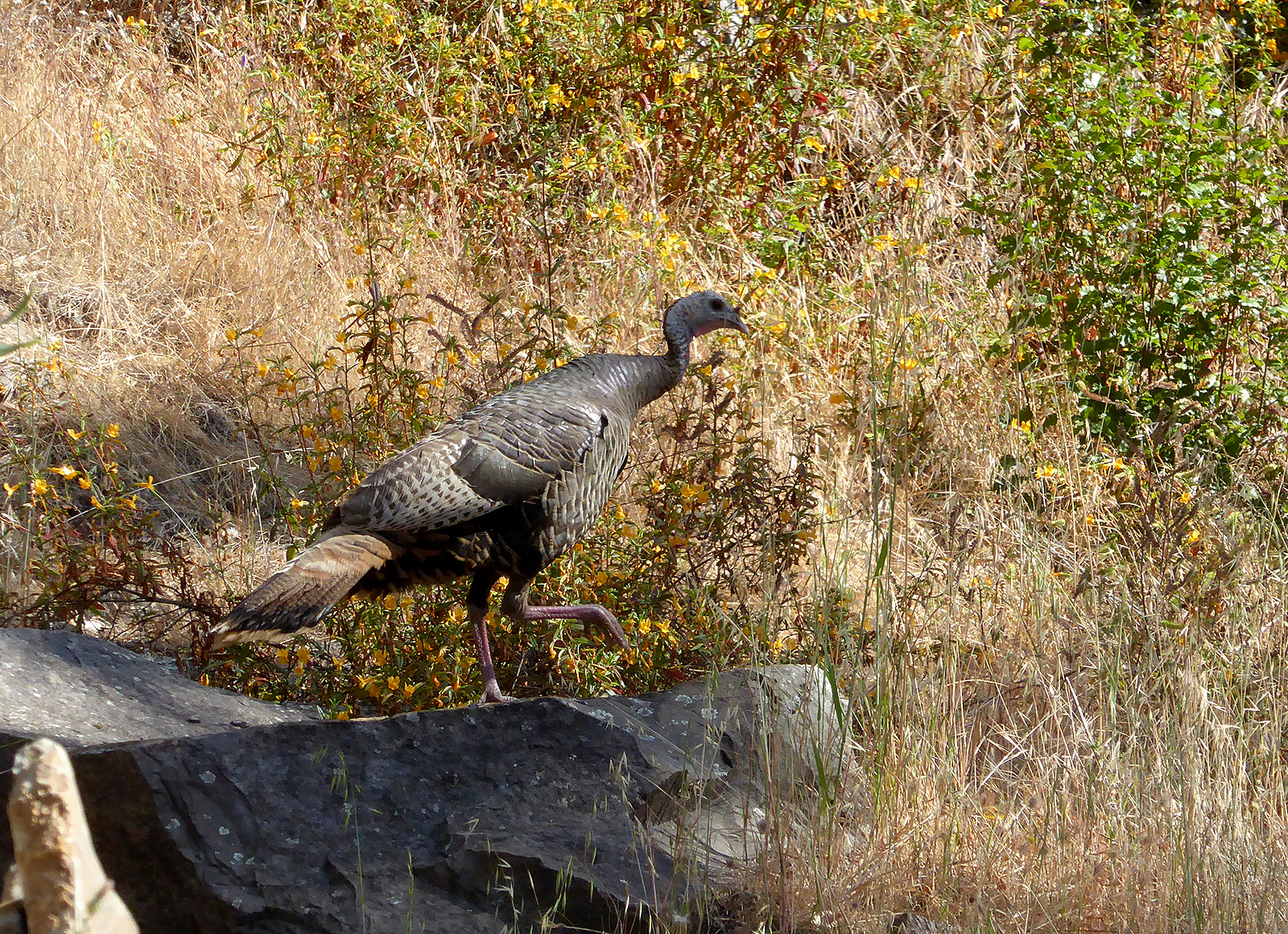
Wild turkeys are common sights on the Montini Preserve and the Sonoma Overlook Trail. Just the other day I spotted a flock of parents and young ones in the Red Quarry on the Montini Open Space Preserve. But I’ve also seen wild turkeys many times before, including during a rainstorm.

Although definitely not widespread in California (according the California Department of Fish and Wildlife, they occupy about 18 percent of the state), wild turkeys are fairly common in Sonoma County. I live in the hills of Boyes Hot Springs and we have seen them in the neighborhood not all that far from the Montini Preserve.

The turkeys we have in California can be considered non-native, although turkeys existed in California some thousands of years ago. So technically, as at least one person has argued, they can be considered to be “reintroduced” to the state. They can become a nuisance to humans at times if their populations increase enough, but so far I would have to say that they don’t seem to have reached such levels locally. At least from my experience the times that I have spotted them have been few enough to be surprising and delightful.

But even if such sightings were not happy occasions, wild turkeys would never be able to drag me away from the Montini Open Space and Sonoma Overlook Trail. Just sayin’.

The Role of Raptors and Other Predators

A Red-Tailed Hawk.

A Red-Tailed Hawk.

raptor – “a bird (such as an eagle or hawk) that kills and eats other animals for food” – Merriam Webster

Raptors are of course a natural part of the Sonoma Overlook Trail and Montini Preserve. The Red-Tailed Hawk, perhaps our most common raptor (at least the most commonly sighted) can often be seen wheeling above the meadows or perched high in an Oak tree. It is a primary carnivore, meaning that it eats herbivores. Other raptors such as the Great Horned Owl, are secondary carnivores, which means it also eats some species of carnivores (such as the Red-Tailed Hawk).

All carnivores, through keeping the populations of herbivores in check, help to create a balanced ecosystem. This role was brought home most famously by what has been called “the lesson of the Kaibab.” This refers to the Kaibab Plateau at the Grand Canyon in Arizona, where President Theodore Roosevelt created the Grand Canyon National Game Preserve.

To protect the game species (largely deer), predators such as mountain lions and coyotes were killed in large numbers. The deer population therefore took off and became so large that they damaged the ability of the land to sustain them, and their population crashed to below where it had been in the first place.  Thus was painfully learned the lesson of the role of predators in keeping an ecosystem in balance.

So the next time you see a hawk with a snake in its claws or a coyote carrying a gopher, know that this is all part of keeping things in balance.


Dragonflies Aplenty

I’ve always been fascinated with dragonflies — their often bright coloration, their way of darting about when flying, their large size for an insect. So I was delighted to get photos of two specimens on today’s hike — one on the Overlook Trail and another on the Montini Preserve.

dragonfly1The first one I saw was this Flame Skimmer (Libellula saturata), perched in a dead bush. I stayed on the trail and used my 30x camera zoom to get in close. The lacy wings are particularly beautiful in full size (click on the image).

Dragonflies are actually quite ancient. According to Wikipedia, fossils have been found from 325 million years ago. They were much, much bigger back then, with wingspans of up to nearly 30 inches. They are capable of four different styles of flight, which allows them to fly in six directions: upward, downward, forward, backward, to the left, and to the right.

dragonfly2I then encountered this Bison snaketail (Ophiogomphus bison) sitting on the Holstein Hill trail on the Montini Preserve, where it crossses the meadow at the top of the hill.

Dragonfly feeding habits? According to Wikipedia: “They are almost exclusively carnivorous, eating a wide variety of insects ranging from small midges and mosquitoes to butterflies, moths, damselflies and smaller dragonflies. A large prey item is subdued by being bitten on the head and is carried by the legs to a perch. Here the wings are discarded and the prey usually ingested head first. A dragonfly may consume as much as a fifth of its body weight in prey per day.”

Dragonflies have inspired a lot of art, from Tiffany stained glass lamp designs to Haiku, such as this poem by Matsuo Basho:

Crimson pepper pod
add two pairs of wings, and look
darting dragonfly

May you see a dragonfly or two the next time you hike the trails. You will be glad you did.