California Naturalist Training in Sonoma

“California is an incredible place to be a naturalist.”

So begins “The California Naturalist Handbook,” the standard textbook for a rigorous UC-approved course designed to turn local nature lovers into trained California Naturalists. These knowledge keepers act as park docents and as key leaders in the “citizen science” movement helping to shape California’s future.

Right now, Sonoma Ecology Center is teaming up with the University of California Division of Agriculture and Natural Resources to offer this accredited eight-week course locally – and we’re looking throughout Sonoma and Napa counties for people interested in joining the elite and venerable league of California Naturalists.

The course results in real college credits – but even better, it turns nature lovers into certified graduates of the UC California Naturalist Program, making them valuable authorities on California’s plants and animals, geology and soils, water, climate, biodiversity and much more.

California Naturalist courses are available at certain locations throughout the state, but this is the first time such a course will be offered at Sugarloaf Ridge State Park. The course, held Monday evenings from 6 to 8:30 p.m., will run from Sept. 19 to Nov. 19 at Sugarloaf Park’s Robert Ferguson Observatory. Speakers will include professors from local colleges and universities and experts from Cal Academy and the Sonoma Ecology Center.

The course also will include four five-hour fieldtrips (Oct. 8th, 22 and Nov. 12, 19) lead by field experts in and around Sugarloaf Ridge State Park. As their final project for the program, each naturalist-in-training will complete an eight-hour volunteer service learning project for a community organization. Participants of this course will graduate with a specialized knowledge of the oak woodlands indigenous to the Mayacamas Mountains.

“We are thrilled to be offering the California Naturalist certification training this fall as an expansion of our education programming at Sugarloaf,” said Sonoma Ecology Center educator Tony Passantino. “Bringing an accredited college course to this state park at the heart of Sonoma and Napa valleys is a rare opportunity.”

Here Be Snakes

rattlesnakeAs I set out on my hike in the warm morning air, I realized that today would be a likely day to see a snake. Today was predicted to be a hot day following on a warming trend over the last several days. It proved to be prophetic, as a group of us who converged on the Overlook upper meadow at about the same time were treated to spotting a gopher snake (see picture from a previous sighting).

Gopher snakes have similar markings to a rattlesnake, so they are often mis-identified. The simplest way to tell is to look for rattles — if the snake has rattles, it’s a rattlesnake, if it doesn’t, it’s a gopher snake. The gopher’s head is also not as spade-shaped as a rattlesnake.

Although many people are afraid of snakes — and especially the poisonous rattlesnake — snakes are a necessary part of our ecosystem. Without predators, ecosystems can fall tragically out of balance and perhaps damage an ecosystem irreparably. They also tend to avoid humans if they can, and it’s usually only when they are surprised or cornered do they strike.

In a conversation later the same day, a man recounted the story of a relative running the trail just last week who was nearly bitten by a rattler as she ran past. It missed because she was in rapid motion, but it was likely because she was in rapid motion and going past the snake in close proximity that it chose to strike. This is why it is very important to watch the ground ahead of you, especially when running. When hiking the snake usually has time to sound a warning before you get too close. I have had this happen on the trail.

So now that snakes are out of hibernation and on the Montini and Overlook properties, stay alert! If you can avoid riling up a snake it can be a pleasant outdoor experience to see a predator up close and watch it slide away into the grass. Let’s hope this describes all of your future snake encounters.

Getting Close to Wildlife Without Getting Close

HummingbirdintreeI’ve been an avid nature photographer for close to 45 years, and I’ve always been a fan of the zoom lens. Zoom lenses allow you to not only bring distant objects near, they can also provide a way to frame the shot the way you prefer instead of cropping it later with software.

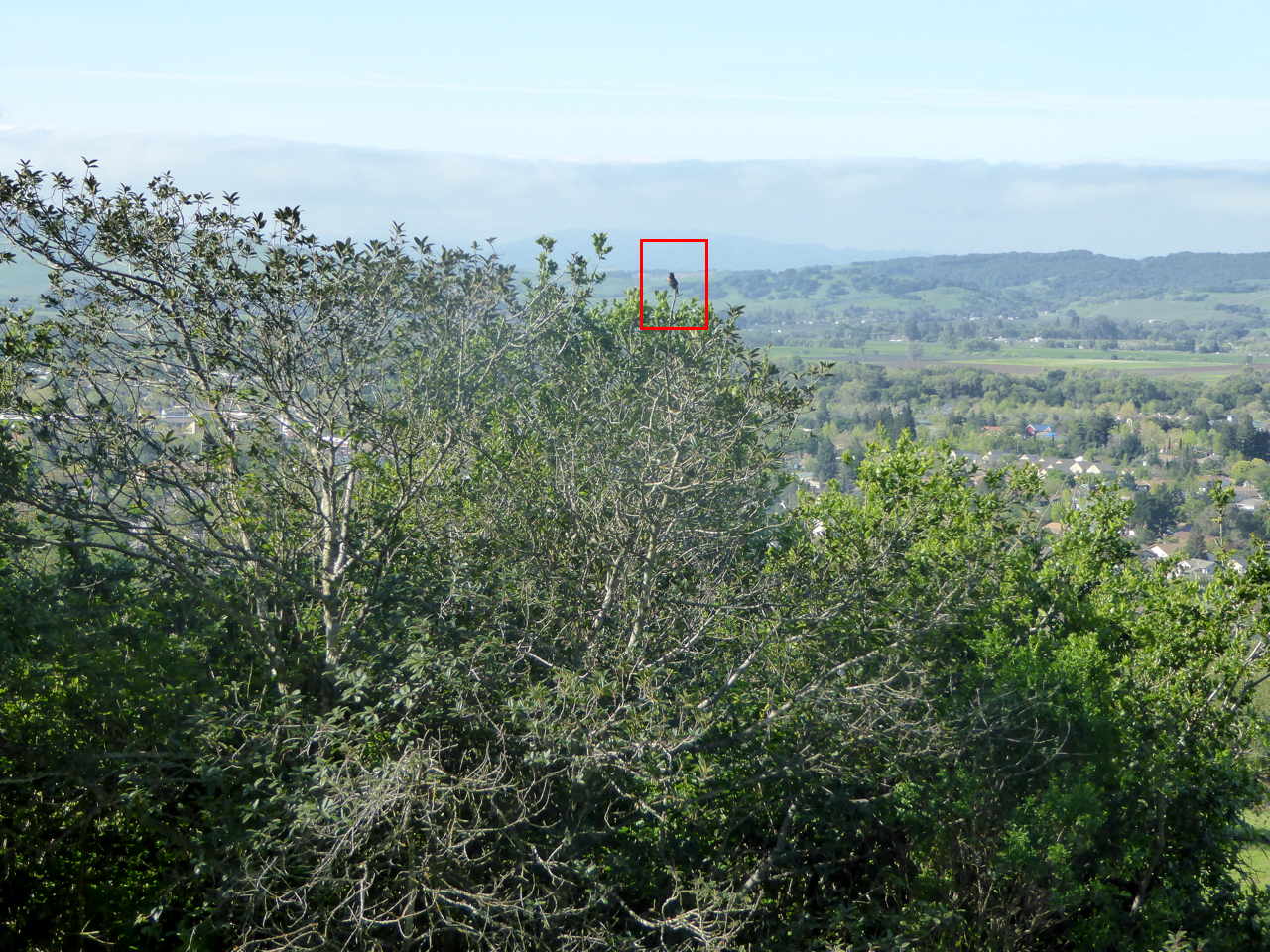
Recently on the trail I was reminded about how important zoom capability can be when I spotted a hummingbird landing on a branch at the top of a tree. Despite the fact that the hummingbird was small (naturally) and the tree was some distance away (see photo), I was able to use the 30x zoom on my little point-and-shoot camera (at the moment the Panasonic Lumix DMC-ZS40), to zoom in on the little thing and get some shots that made it look like I could reach out and touch it (see second photo). Neither photograph has been cropped.

HummingbirdIf you are interested in achieving this kind of capability, these kinds of cameras are referred to as “super zooms”. Super zoom cameras come in all kinds of configurations, from general consumer kinds of cameras to “prosumer” to expensive professional rigs. As a hiker, you will most likely want a compact “point-and-shoot” camera that you can slip into a back pocket. If you are in the market for such a camera, here is a good web site outlining some of your best options.

Happy photographing!

Flowers Everywhere

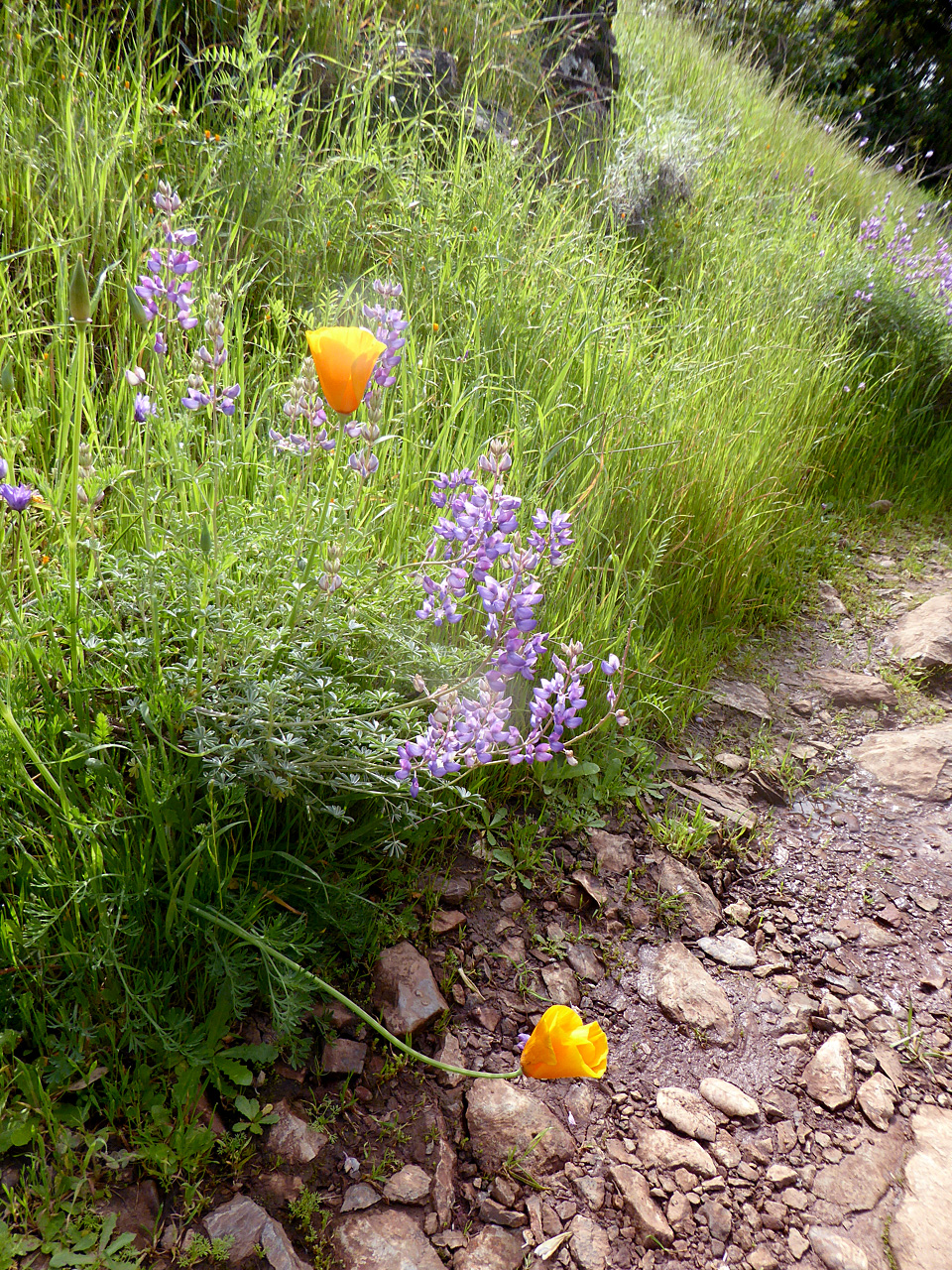
P1000924If you like flowers, then now is the time to hike the Overlook and Montini trails, as they are going nuts. From California poppies, to Lupine, to you name it, they are out in great profusion. The picture to the right was taken just a few days ago on the Overlook Trail, where you can see both Lupine and Poppies hanging over the trail.

There are many other flower varieties out at this time, and others on their way. Spring is in full flower, and it is awesome.

However, keep in mind that other plants are going crazy right now, and among them is poison oak. Although we recently cut it back, it is still growing and we will likely need to cut it back again soon. Also, since the grass is growing like mad and often over-hanging the trail, keep an eye out for ticks. They like to climb up onto the tips of grasses where wildlife (and we count) are walking by so they can hitch a ride.

For tips on what to do if you are bitten, see this earlier post where I describe my own experience.

But by and large, it’s all good out there on the trail, and experiencing our wildflower bloom is well worth any slight risks.

Watch Out for Ticks!

2562198878_e548ea735c_zYesterday, likely due to my work in cutting back poison oak on the trails, I found a tick on me. Freaked out by the possibility of contracting Lyme disease, I quickly found a pair of tweezers and pulled the tick out, trying carefully to grab it from the head rather than squeezing the body. It was difficult, as it was quite tiny. The bite spot is still red and sore. But the important piece of information is this: save the tick, so it can be tested for Lyme Disease.

But as this Press Democrat article points out (helpfully published the day I found the tick), the actual incidence of Lyme disease in Sonoma County is not high, despite the fact that we have had the most reported cases in California in recent years.

To prevent tick bites, the Sonoma County Department of Health Services recommends:

  • Walk in the center of trails.
  • Use repellents that contain 20 to 30 percent DEET on exposed skin and clothing for protection that lasts up to several hours. Treat clothing and gear (boots, socks, pants, tents, etc.) with products containing 0.5 percent permethrin.
  • Bathe or shower as soon as possible after coming indoors, preferably within two hours.
  • Conduct a full-body tick check; parents should check children under arms, in and around ears, inside belly button, behind knees, between legs, around waist, especially in hair.
  • Examine gear and pets, which can bring home ticks that will then attach to a person.
  • Tumble clothes in a dryer on high heat for up to an hour to kill remaining ticks.

Remember that ticks that carry Lyme disease can be very small — about the size of a poppy seed. The biggest danger comes when the tick bite goes undetected and the disease is allowed to fester without antibiotics to fight it. Long-term effects are possible in these cases.

Therefore, it’s wise to know what the symptoms of Lyme disease are so if you have any of these you can contact your doctor immediately (from the Mayo Clinic):

“These signs and symptoms may occur within a month after you’ve been infected:

  • Rash. From 3 to 30 days after an infected tick bite, an expanding red area might appear that sometimes clears in the center, forming a bull’s-eye pattern. The rash (erythema migrans) expands slowly over days and can spread to 12 inches (30 centimeters) across. It is typically not itchy or painful.Erythema migrans is one of the hallmarks of Lyme disease. Some people develop this rash at more than one place on their bodies.
  • Flu-like symptoms. Fever, chills, fatigue, body aches and a headache may accompany the rash.”

If these symptoms are not spotted or recognized, later signs may appear in the following weeks and months. See the Mayo Clinic web site for more information.

So stay safe out there, and be vigilant!

Photo by wahoowins, Creative Commons License CC BY-ND 2.0