Tour beautiful Oak Hill Farm during fall harvest and help support the all-volunteer Sonoma Overlook Trail

home_slideshow_1_0You are invited to join Oak Hill Farm owner Anne Teller for a guided walking tour of her sustainably-farmed fields of flowers, vegetables and and fruit orchards on Saturday, October 1st from 10:30AM -1PM.

Oak Hill, a 25-acre farm at the foot of the Mayacamas and known to many by its distinctive Red Barn Store, is one of Sonoma Valley’s treasures. The Teller family has practiced sustainable agriculture for more than 50 years and harvests 200-plus varieties of organically-grown vegetables, fruits, flowers and herbs as they naturally come into season.

The farm is part of a larger, 700-acre property held in perpetuity as protected wildlands.  Anne will be delighted to talk with us about the Tellers’ commitment to sustainable farming and to stewarding Oak Hill’s incredible natural resources.

This is an easy, flat walk of about two miles round-trip. Afterwards we will enjoy a discussion with a light lunch and wine.

The walk is limited to 40 people and reservations are required. A donation of $45 will secure your space.

All proceeds go toward upkeep of Sonoma Overlook Trail. The public trail is managed on an all-volunteer basis by a group of Sonomans who donate their time to keep the trail in good repair, protect natural habitat, assist visitors and lead hikes.

To place a reservation email us at  LaurieSOT@gmail.com

To learn more about Oak Hill farm, please visit oakhillfarm.net.

We’re Winning!

P1010218Faithful readers of this blog (all two of you, and one is my Mom) will know that we’ve been fighting the good fight against the invasive non-native Yellow Star Thistle on both the Overlook and Montini properties. The season for pulling it runs from mid-May to August. Now that we are in August, when the weed dries out and the seed heads drop off, we must quit.

But I’m here to tell you that we are winning the war. This is the second year that I can certify that all of the infestations on the main properties of both the Overlook and the Montini have been essentially cleared. Judging from the number and size of the plants we are pulling in most areas (see the small plants pictured), we are depleting the seed bank, which can be viable for up to five years.

We could not have reached this point without essential assistance from Rich Gibson, a biologist and a Sonoma Overlook Trail volunteer steward, and the Sonoma Ecology Center’s EnviroLeaders program. Twice, at least half-a-dozen teenagers from the EnviroLeaders Program came out and helped decimate the worst patches of Yellow Star Thistle on the Montini Preserve. Tony Passantino, the SEC’s EnviroLeader’s program manager, has been very willing to bring his team out to support our removal efforts whenever we called for help. And the teenagers who are a part of this program are willing hard workers and ready to learn about the environment and how to keep it great. We so appreciate their help.

Next season expect a call to go out for help in decimating this scourge. And if you see it, please consider helping. The situation gets better every year, but we are still years away from eradicating it completely. We can use your help to make YST only a memory on these properties.


Once More Unto the Breach

IMG_1263Lately I’ve been too busy with a more important project to get my daily hike in on the Overlook and Montini trails. But yesterday I cleared some time and made my way there. I knew that we were well into the season of the invasive Yellow Star Thistle, so I took along a feed sack to pull what I could.

Those of you keeping score at home likely know that the Overlook Trail Stewards have been waging war against this pest, and that war has been stepped up in recent years. Last year we were successful in eradicating it from the main Overlook and Montini properties. We knew it would be back this year, but we also figured that given how we beat it back last year it likely wouldn’t be as bad.

Having inspected a couple locations where it was bad last year I’m happy to say that it isn’t nearly as bad this year. We are indeed making progress, but we also know that this is a multi-year war and that it will require us to be vigilant and relentless.

This war is led by volunteer Steward Rich Gibson, who has called work days for groups to get together and take out both Yellow Star Thistle and Scotch Broom – another non-native that has a tendency to take over the landscape. Without efforts such as these our landscape would look very different than what it should be, and has been for centuries.

Here Be Snakes

rattlesnakeAs I set out on my hike in the warm morning air, I realized that today would be a likely day to see a snake. Today was predicted to be a hot day following on a warming trend over the last several days. It proved to be prophetic, as a group of us who converged on the Overlook upper meadow at about the same time were treated to spotting a gopher snake (see picture from a previous sighting).

Gopher snakes have similar markings to a rattlesnake, so they are often mis-identified. The simplest way to tell is to look for rattles — if the snake has rattles, it’s a rattlesnake, if it doesn’t, it’s a gopher snake. The gopher’s head is also not as spade-shaped as a rattlesnake.

Although many people are afraid of snakes — and especially the poisonous rattlesnake — snakes are a necessary part of our ecosystem. Without predators, ecosystems can fall tragically out of balance and perhaps damage an ecosystem irreparably. They also tend to avoid humans if they can, and it’s usually only when they are surprised or cornered do they strike.

In a conversation later the same day, a man recounted the story of a relative running the trail just last week who was nearly bitten by a rattler as she ran past. It missed because she was in rapid motion, but it was likely because she was in rapid motion and going past the snake in close proximity that it chose to strike. This is why it is very important to watch the ground ahead of you, especially when running. When hiking the snake usually has time to sound a warning before you get too close. I have had this happen on the trail.

So now that snakes are out of hibernation and on the Montini and Overlook properties, stay alert! If you can avoid riling up a snake it can be a pleasant outdoor experience to see a predator up close and watch it slide away into the grass. Let’s hope this describes all of your future snake encounters.

Getting Close to Wildlife Without Getting Close

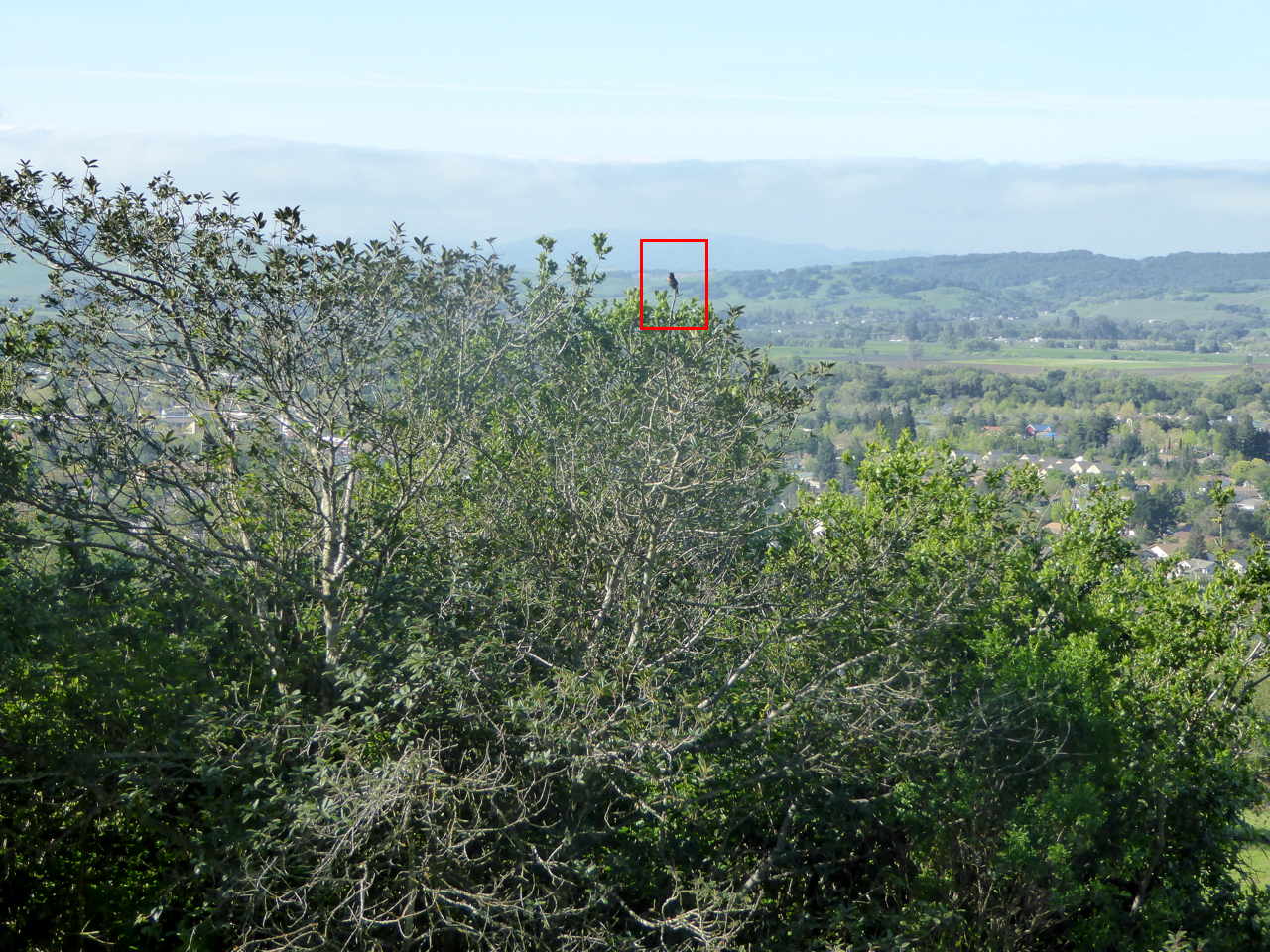
HummingbirdintreeI’ve been an avid nature photographer for close to 45 years, and I’ve always been a fan of the zoom lens. Zoom lenses allow you to not only bring distant objects near, they can also provide a way to frame the shot the way you prefer instead of cropping it later with software.

Recently on the trail I was reminded about how important zoom capability can be when I spotted a hummingbird landing on a branch at the top of a tree. Despite the fact that the hummingbird was small (naturally) and the tree was some distance away (see photo), I was able to use the 30x zoom on my little point-and-shoot camera (at the moment the Panasonic Lumix DMC-ZS40), to zoom in on the little thing and get some shots that made it look like I could reach out and touch it (see second photo). Neither photograph has been cropped.

HummingbirdIf you are interested in achieving this kind of capability, these kinds of cameras are referred to as “super zooms”. Super zoom cameras come in all kinds of configurations, from general consumer kinds of cameras to “prosumer” to expensive professional rigs. As a hiker, you will most likely want a compact “point-and-shoot” camera that you can slip into a back pocket. If you are in the market for such a camera, here is a good web site outlining some of your best options.

Happy photographing!