A Long Day’s Journey Into the Fight

Those of you who read this blog regularly (thank you both!) know that I have, well, an obsession about ridding these properties of invasive species — particularly invasive thistle, as it can create entire “no go zones” for wildlife, and completely up-end the natural ecosystem. If you want to know more about why we fight it so hard, here is the chapter and verse about why we do what we do.

But at the moment, in December, we are still in the “down period,” when we can rest, and recuperate from the long removal season. You see, the thistle season begins in January — or even the end of December — and it extends well into August. Thus, we have eight months on, essentially, and four off.

So perhaps you can understand what I’m feeling as I spend my last few weeks as a free person before buckling down in January for another eight months. I’ve enjoyed hiking the last several months a lot. I’ll still hike during thistle season, but usually just when a friend can come along. Otherwise, I’ll be out there, pulling like always. I rush to say, however, that every year it gets better, and there may come a time when there is even no thistle at all. But we’re not there yet.

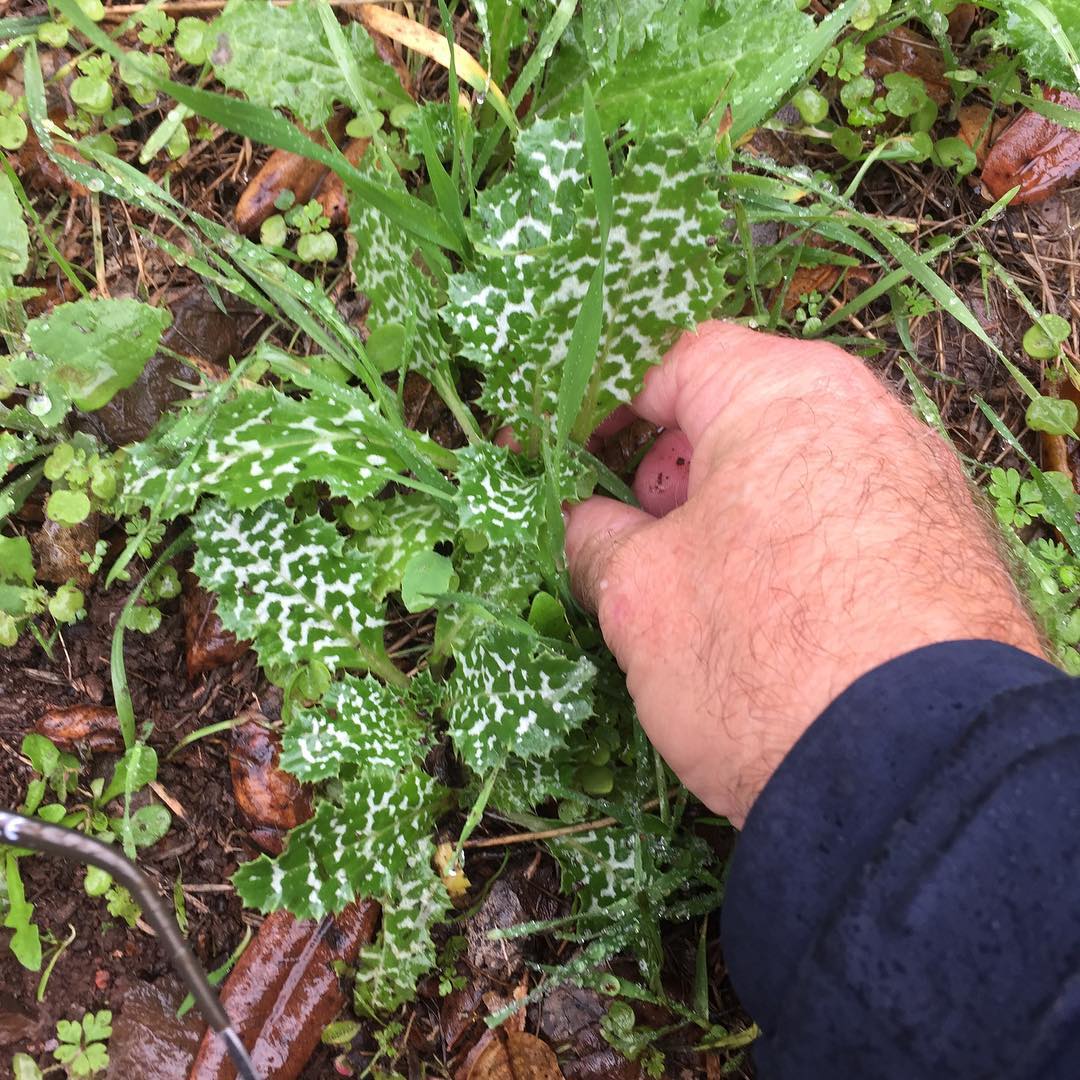
That’s why, if you see me out there in January, pulling Italian Thistle (pictured), you’ll know it’s a long game, fought over years and decades, and at least I’ve had four months off to simply enjoy the properties that we are fighting to save. And like I said, every year it gets better. Before very long, I believe, I will have 12 months to hike. I can’t wait.

Prepping the Trails for Rain

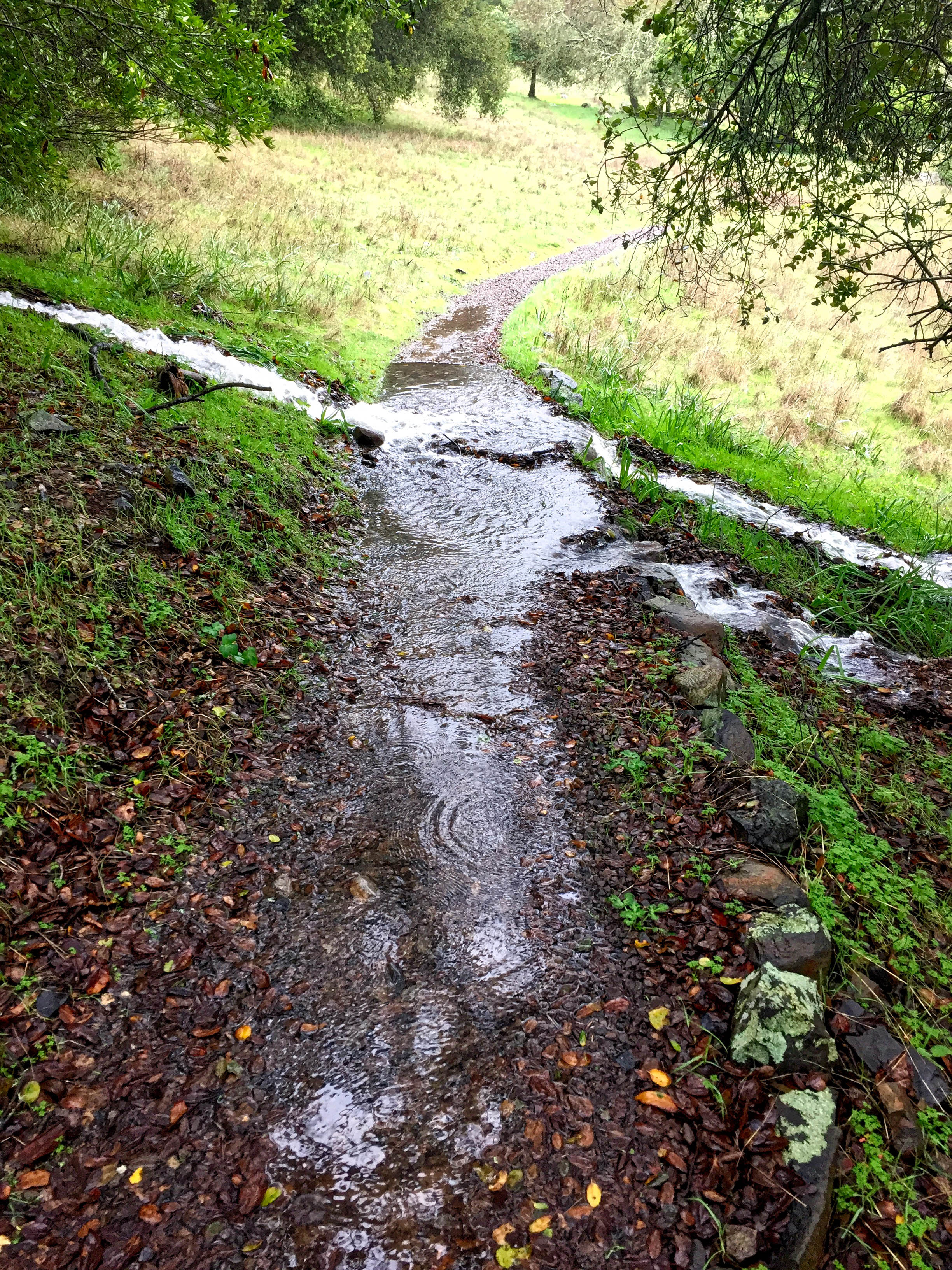
Since rain was predicted for today (and it came!) I headed out earlier in the week with a mattock to clear trail drainage channels, which had become clogged with rocks, leaves and miscellaneous debris since spring. Water must be guided off our trails immediately or else it will erode the trail and harm it, especially over time. Plus we don’t want the soil that gets eroded to end up in our waterways.

I also cut new ones where I thought they may be needed. Some of this work is obvious, but I know that additional work will be needed once we actually have flowing water on the trails and can see the trouble spots, where water is pooling or running down the trail.

This is just one task that the volunteer stewards group does throughout the year to keep our trails safe and well-maintained.


The End of Invasive Broom

One small portion of where the action happened.

Sorry, the title is a bit over the top, but titles should be dramatic, or at least evocative, I assert. In reality, it is the end of invasive broom this season. We will likely need to return to the big patch I removed recently in subsequent years, with vigilance and due diligence. But at least, for now, it’s gone. This is the first time this has happened on the Sonoma Overlook Trail property.  The Montini Preserve has never had broom, as far as we can determine.

Accomplishing this took several weeks of effort, an hour almost every day. I even began to get a repetitive stress injury from pulling too much with my right arm, and had to back off a bit. Pulling broom is harder than pulling thistle — so much harder that I had to buy a special tool to pull the largest plants. Called the “Weed Wrench” (see photo to the left), it is a rather imposing chunk of metal that mechanically allows you to grip the broom at its base and lever it from the ground. Although they call the one I bought their “light” version, I think it could be designed to be a lot lighter than it is. But whatever, at least it works.

One day, when doing this work, I returned to my car to discover I was without my keys — they had fallen from my pocket as I was pulling. I had to go  retrace my steps at least three times, from my car to the patch, around the patch and back, before I finally saw a sparkle in the forest duff from the tiny, bright green flashlight on my keychain. I was grateful.

I’m also grateful that we are making significant progress on fighting invasive species on these properties. We are winning, as every year it gets better. We are still far from the end, but I think I’m beginning to at least see that it’s possible to win. For a number of years, I had to take it only on faith. Now I have experience and a sense of surety. We can do this. I know we can.

A New Steward with the Right Stuff

Yesterday I welcomed a new steward to the group. She can frequently be seen out on the trail, and she has for years picked up trash on the trail and performed similar tasks to help maintain our trails, so this is kind of like making official what has been reality for quite some time. When I met her at the trail this morning, she had already carried out a rusty bedspring that had somehow been deposited near the trail between the trailhead and the Rattlesnake Cutoff junction.

She had also just this week reported a big rock in the middle of the SOT just before the junction with Rattlesnake Cutoff (see picture). She reported it as being very heavy, and said that she couldn’t budge it. I said that I had a plan, and she asked to accompany me to deal with it. I’m glad she did, as I needed all the help I could get on this one.

I knew we needed to have some serious mechanical advantage, and I knew just how to get it from my commercial whitewater rafting days. When you have to pull a rubber raft off a rock that it’s wrapped around, you also need some serious mechanical advantage and I had the necessary gear to do it.

Using a long static (non-stretching) line, three pulleys, two prusiks, various lengths of one-inch webbing tied permanently into circles (these we wrapped around the rock), and plenty of locking carabiners, we set up a 5:1 z-rig system. That allowed us to first tip the rock over to the edge of the trail. We then changed anchor points (trees) to pull the rock in a different direction off the trail, as we had to avoid a tree.

It was a close thing. I was just about ready to call it when the rock started to tip the second time. Encouraged, we buckled down and finally it fell over off the trail (see photo).

Even if she doesn’t pick up another tissue from the trail, she has earned her steward name tag. She definitely has the right stuff.

The Beginning of Scotch Broom Season

Scotch broom: vanquished foes in the foreground, those yet to be pulled in the background.

This year I’ve decided to make our invasive species removal program extend all year. Thistle season can begin as early as late January and extend into August, until it can no longer be usefully pulled. But you can pull Scotch broom virtually any time of year, so I am turning to it now at the end of thistle season.

We have a large patch of it on the Overlook Trail property, at the edge of the cemetery. I will work on this patch until it is completely gone, then look for other infestations. Although most of it can be pulled by hand (some small enough that you can pull multiple plants at once), while others have gotten big enough that I need to use the special tool I bought to lever them out. Since they aren’t going to seed now, I can just drop them and let them die in place.

Let me know if you want to join me, since misery loves company!