The Third Leaf

ThistleWe’re in the very early days of “Thistle Season,” which sadly lasts from November into August. That’s right, those of us who struggle against thistle get something like 2-3 months off a year. And knowing how relentless invasive species can be, that actually seems generous to this obsessed lunatic. Italian thistle starts coming in as early as the rain does while Yellow starthistle doesn’t come in until much later in the season, like around May and extending into August.

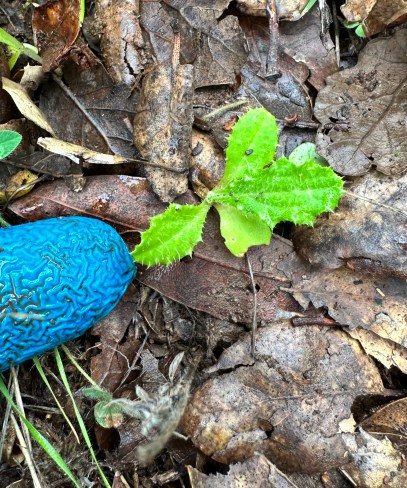
Right now most of the Italian thistle looks totally tiny. Thankfully, I’ve come to recognize Italian thistle as soon as the third leaf comes in. This is because the third (and then later, the fourth) leaf comes in with spikes (see picture). It’s completely unique among the plants found on the Sonoma Overlook Trail and the Montini Open Space Preserve, so you know you have it dead to rights.

And the great thing about pulling Italian thistle now is that all you need to do is to pull it and toss it. Later, when it goes to flower, we will need to bag it up and carry it out. We dump our bags beside the dumpster in Mountain Cemetery next to the City Public Works Yard. Most years the pile gets to be about ten feet in circumference and about five feet high.

But before we even begin to create that pile we’ve pulled thousands of plants and tossed them aside. Starting with the plants that show that tell-tale third leaf.


Dia de los Muertos • Day of the Dead Cemetery Tour

Tour Sonoma History through Mountain Cemetery

Saturday November 4th, 2023
10 am OR 12:30pm
$40 Suggested Donation
REGISTER

The Sonoma Overlook Trail Stewards invite you to take a lively, informative walk through our historic cemetery with our own amateur historian Fred Allebach.

Meet ranchers and ranch hands, real estate tycoons, farmers and farriers, carpenters and stone masons, quarry-men, grocers, butchers, bakers, maybe a candlestick maker, and many more! This fundraising event is limited to 25 participants per hike. We sell out every year, so register early to be sure you get a spot!

We’ll have a hike at 10am and another at 12:30. Your $40 donation includes the walking tour, cookies and cider. All proceeds go toward improvements on the Overlook Trail. The Trail is solely supported by private donations.

The Third Wave

IMG-2727I’ve been pulling Italian thistle (an invasive monster) since mid-November. It’s now mid-March and we still have very young plants coming in (see pic, gloved finger for scale). Today, I decided to call it the “third wave” but I have no idea if it comes in waves at all, or just constantly. Or if it comes in waves, how many can we expect? Five? Ten?
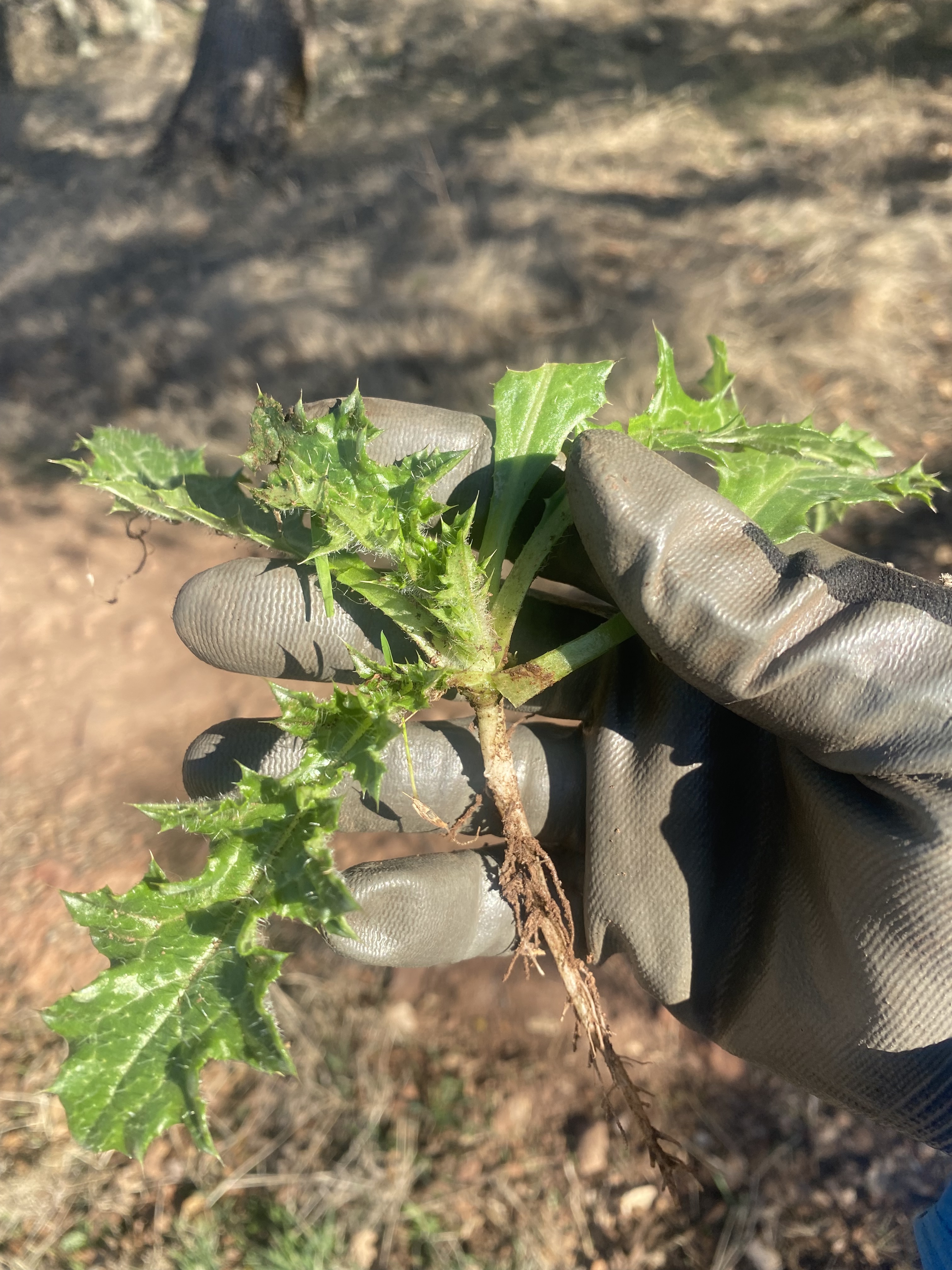
All I know is that it will continue to come in for quite some time, and I need to keep an eye out for these little guys probably well into May. Part of the reason may be the very wet winter we are having, as none of the thistle is bolting yet but the plants, in some cases, are becoming very large. This presages a massive stalk, which will mean more bulk to deal with when we need to begin bagging the thistle and carrying it out.

Also, the rain is preventing me from using 30 percent vinegar to battle big patches, since I need sun to follow spraying, not rain that will wash it off. So far we haven’t many stretches of dry weather.

Sorry to be a Debby Downer, but these are just some of the challenges we face when attempting to control invasive thistle on these lands.

Controlling Water on the Trails

The Trail Maintenance Team for the Sonoma Overlook Trail does a variety of tasks, but one of the most important things we do is manage the flow of water across the trails. Essentially, what we try to do is to move the water off the trail as soon as it comes on. The best way that this happens is in sheet flow from the upper side of the trail to the lower side, but that is rarely the situation we can accomplish.

One challenge is that water often comes onto the trail not in a gentle sheeting flow, but in what is essentially a tiny creek. Another is that it isn’t always an option to have the water sheet off the downhill side. We often need to allow it to flow down part of the trail before directing it off in a waterbar (a channel we cut in the trail to force the water off the trail).

There are also other structures we build to manage water. Perhaps chief among them is the armored swale. An armored swale is essentially a deep channel you cut in the trail that you “armor” with rocks so it doesn’t erode as the water flows over it and off the trail. Another strategy we use to encourage sheet flow off the trail is cut the “berm” or the very edge of the trail that can build up in a way that keeps water on the trail instead of allowing it to sheet flow off of it.

All of these structures require ongoing maintenance, and the more subtle structures require more maintenance than the more dramatic ones.

Over the last few days (one of them during the recent rainstorm) I was out renewing the structures in place and cutting berm to better enable water flow off the trail. I also deepened a few waterbars and performed other tasks to better channel water from the trail.  I will again be out there tomorrow afternoon during the rainstorm with a shovel, to see what needs fixing. It’s part of what we stewards do.

The Game is Afoot

Picture of an Italian thistle plant.

A young Italian thistle.

I know what all five of you who read this blog are thinking: “Oh no, not again!” you’re groaning. And I don’t blame you.

Yet again I’m blogging about invasive species management on the Overlook and Montini properties, as I have for years. But as you might imagine, there’s a reason for that, and it’s because we’re in a decades-long fight that we may never win.  So buckle up, buttercup, here we go again!

I first sighted Italian thistle popping up in early November. Certainly by November 8, two days earlier than last year, I noticed more than one patch of it. Therefore, today I went out on the Montini Preserve and pulled not only the one pictured plant (the largest one I found today), but also many other, much smaller plants. The game is definitely already afoot, thanks to some early rains.

So far I’ve been unable to tell if our previous work has made much of an impact on the problem. My instinct is that we haven’t yet, that we still have a ways to go to seriously reduce the seed bank present in the soil. There seem to be plenty of plants along the trail on the Montini, which is where I’ve focused much of my attention, so there doesn’t seem to be much progress there. Yet.

But if there’s one thing I know, it’s that invasive species management is a long game. And few people know what the long game takes better than I do, I submit. So once again I saddle up, and enter the fray. I’ll see you out there.