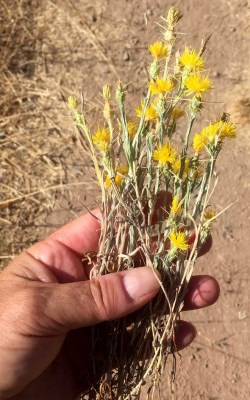
 Earlier I posted about starting the yearly battle with Yellow Star Thistle (YST). YST is an invasive non-native weed that left unchecked can take over entire meadows (it does not do well in shade). The University of California has this to say about it (in part): “Seed output can be as high at 30,000 seeds per square meter, with about 95% of the seed being viable soon after dispersal. Most seeds germinate within a year of dispersal, but some can remain viable in the soil for more than 3 years.” This is an opponent that is difficult to over-estimate.
Volunteers are trying to eradicate this plant all over California every summer, as we certainly do here at Jack London State Park (thank you Linda Felt and other volunteers!) and on the Sonoma Overlook and Montini Preserve properties. So we are now in the second year of a relentless 5-year campaign to completely eradicate this scourge.
Starting in mid-May, even before it was blooming, I began pulling it on my hikes on Overlook and Montini. Since then I’ve been putting in several hours every week pulling it up by its roots and hiking it out. When tackling a large patch I take a large plastic sack, but recently on the Overlook Trail I have been finding so little (see the picture of a recent haul) that I haven’t bothered to take a bag. Over the summer I’ve racked up at least 30 hours of pulling — not counting the time to get to the locations.

Before the battle.
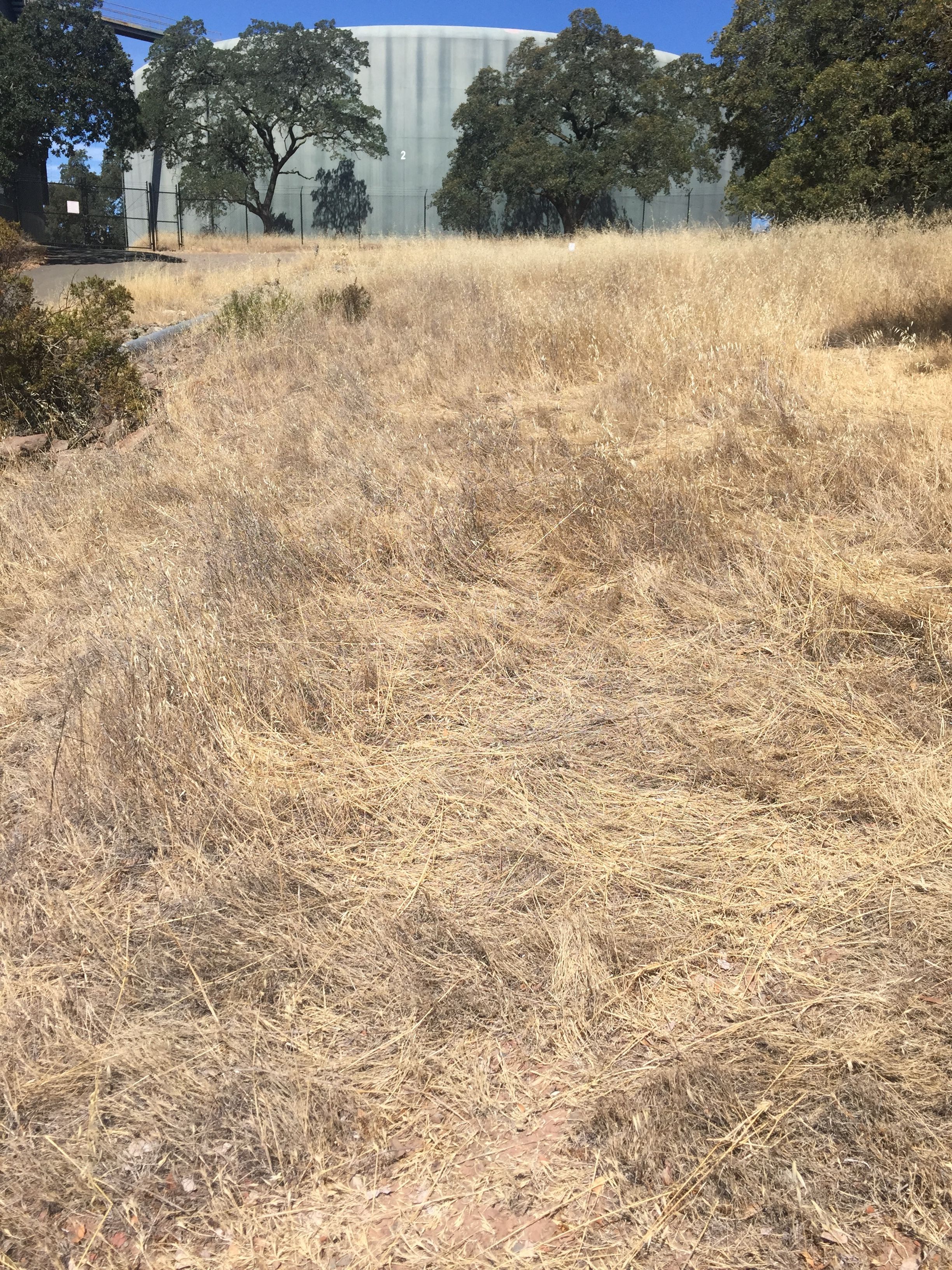
Last year we did such a thorough job on the Overlook Trail that this year it took much less time to keep it in check. The Montini Preserve was another matter, as we hadn’t been checking it last year (it opened to the public in November). I found several significant patches and one really bad patch (see the “before” picture to the left, it covered the entire area pictured and beyond). I was able to get the smaller patches under control with some diligence, but the really bad patch has taken many hours of work spread out over weeks. Only today did I finish clearing this patch (see “after” picture). It’s sweaty work, and raised blisters on my hand even with a glove.
I can now report that as far as I can tell, YST has been effectively removed this season from the main parts of the Montini Preserve and the Sonoma Overlook Trail.

After, August 2nd.
One morning recently I arrived at the really bad patch on the Montini Preserve with three large plastic sacks that I intended to fill, as I had several times before. I surveyed the patch that I had been working on for weeks and saw everything that still remained. I thought about giving up. I had made a lot of progress and I thought we could get it all next year. Why not just quit? No one would know.
I took another look around.
Then I stooped down and began to pull.
Call it what it is — an obsession.

 This is the time of year when the California Buckeye (Aesculus californica) earns its name. Named for the rather large seed pod they drop that resembles the eye of a deer, they are now easily found on the trail.


 Sonoma Overlook Trail • Montini Open Space Preserve