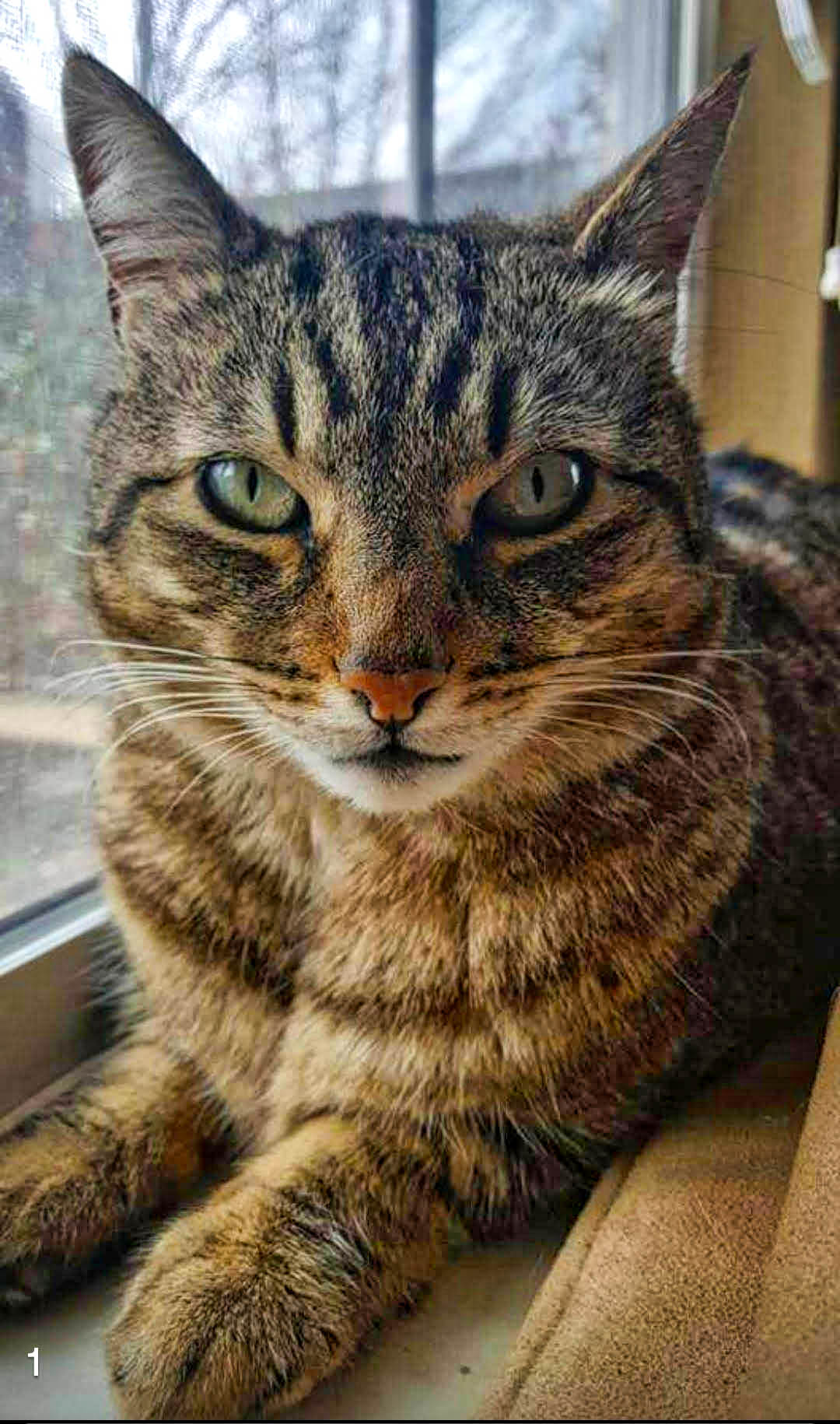
Meet Rigby, the Official Montini Preserve Greeter

Anyone who enters the Montini Preserve from the 4th Street West trailhead knows Rigby the cat. Rigby has essentially “camped out” not far from where the trail starts for years. Hikers often stop and give Rigby some love before hiking up the Holstein Hill trail.

I mean, who wouldn’t? Just look at that face. Rigby is the official trail greeter, and he would have a volunteer name tag if we knew where to…um…pin it.

On Rigby’s part, he accepts the adulation with the equanimity of many cats who believe such worship is simply their due. And, well, it is.

But don’t think for a minute that Rigby is a lost cat. As his owner, Delisa Dodge says, “years ago we moved here and he loved to go down there every day because he loved the attention. He is well fed, vaccinated, treated for fleas and ticks and he is one happy cat.”

She even says that since so many people think Rigby is a lost cat, they scoop him up and take him to Pets Lifeline, but he is chipped and he is a “frequent flyer,” so they know to return him to Delisa. But, Delisa says, “everytime we come home he’s here for about 10 minutes and runs back to the trail.” Clearly he loves to hang out and soak up all the hiker love and treats.

I mean, who wouldn’t? Maybe I should look into that gig. Would you stop and pet and feed treats to a 64-year-old man? Yeah, I thought not. I guess I need to keep my day job after all.

New Overlook Trail Kiosk Panels!

Photo by Susan Peterson

New kiosk panels at the Overlook Trail trailhead were installed recently, after many months of thoughtful work. They have replaced, in some cases, outdated and fading panels, and in others added information that we had decided over time would be useful additions, such as trail descriptions that could help hikers understand what the different trails have to offer. Please take time to check them out when you are next on the trail.

This work was originally led by Lynn Clary, but after he left the stewards group, it was taken up by John Donnelly and brought to completion. Other stewards involved in this work include Lori Parmalee and Priscilla Miles.

The design and production of the panels was very ably accomplished by the good people at ASA Graphics, who also designed our logo. They were excellent to work with, and they came and hiked the trail to better get a sense of what we are about. Rochelle Zatkin, the principal, met with us multiple times, and has made sure that her staff understood us and also only charged us fees appropriate to a volunteer-led non-profit. We simply could not have had a better partner in this journey, in my personal opinion.

Meanwhile, the head of our Communications Team, Jeni Nichols, has already swept into action and created a new display along with the help of Susan Peterson, to create a display for our renewed “Hiker’s Gallery.” Please understand that this area is free for anyone to use. If you have a display you would like to create, just contact Jeni Nichols. We would love to see your contributions!

That orange peel you just tossed aside? Yeah, don’t do that.

Facial tissues are the one piece of trash I see on the trail the most (by far), but I also see an occasional orange peel or apple core. I know where hikers who toss these aside are coming from — since they are food items, the idea is that either an animal will get it, or mother nature will.

The problem is that often neither of those are true. If an animal does not eat your leftovers (which is much less likely than you think), then it is going to be there for quite a while. But don’t just take my word for it.

In an article published in Popular Science, Alisha McDarris writes that “…food scraps like orange and banana peels can take up to two years [emphasis added] to break down in the wild, meaning they’re going to be sitting alongside the trail or in a ditch by the road for a lot longer than you might think.”

The essential problem is that the great outdoors is not like a compost pile. A compost pile is a situation that is supremely optimized to enhance the breakdown of organic matter. This is a very different environment, as it turns out, then simply beside a trail. “The conditions present in a compost pile or facility—like a microbe-rich environment, heat, and the frequent turning of materials,” writes McDarris, “are required to break down food waste so quickly. Those conditions don’t exist in nature.”

And it gets worse, as McDarris lays out:

The food itself can also make animals sick and even kill them. Most of what people leave outdoors—peels, cores, and trail mix, to name a few—is almost never food that’s part of animals’ normal diet. Often, they can’t decipher the difference between actual food and scented items like chapstick, potato chip bags, and snack bar wrappers, which can be fatal.

https://www.popsci.com/story/diy/what-happens-food-trash-outdoors/

So yeah, the cardinal rule of trails remains: If you pack it in, pack it out. Thank you very much, from the person who has to pick up the shit you leave behind.

New Permanent Trail Signs

Lynn with one of the new signs.

Today Lynn Clary and I installed several of the new permanent trail signs on the Sonoma Overlook Trail, and tomorrow we will install the rest. This is the result of a few years of collective work led by Lynn Clary, from designing the signs and the wording, to creating drafts to put on the trail for testing and getting feedback, to working with a designer and production company, to having the signs produced after a COVID-19 delay, to working with our design company to create a new logo for the trail, and finally getting the signs produced, delivered, and installed. We hope you like them. We do.

We take sign design seriously, and we spent quite a bit of time laboring over every word and symbol. Is it clear, we would ask ourselves? Would it cause confusion? Did each word add something, or was it superfluous? Should the signs have the City of Sonoma seal or just the trail logo? Everything was questioned along the way.

Lynn Clary deserves the bulk of the credit for this accomplishment. He began the process, carried it forward, and has now finished it, despite leaving the Stewards group a while ago. His love for, and commitment to, the trail remains, and we frequently meet on the trail as we both spend a lot of time there.

We hope you do too, and that you find the signs helpful, or at the very least not confusing.

Thanks Roy!

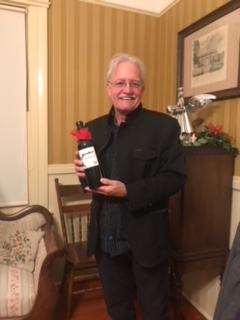
Roy Tennant, Overlook Steward,  was awarded a gift for the enormous amount of hours he has spent,combatting invasive species including poison oak, and caring for the Trail. image1