
TRANSCRIPT:
[Sonoma Overlook Trail]
Welcome to the Sonoma Overlook Trail podcast. I’m Jess from the Overlook Trail Stewards.
In honor of the Chinese New Year of the Wood Snake, my guest today is Galen Freed-Wilhelm, a local snake handler and reptile educator. In addition to his love for reptiles, he has a deep passion for environmental causes and actually received the Youth Environmental Award from Sonoma County Conservation Council.
Among other endeavors, Galen volunteers at Sugarloaf Ridge State Park in Kenwood, California, where he leads nature walks, works on the trails, and relocates rattlesnakes from the campground there.
Welcome, Galen. Good to have you.
Galen, can you tell me a little bit about how you got started with your career and or experiences with snakes?
[Galen Freed-Wilhelm]
So I first became interested in snakes probably a little over ten years ago, when I found a garter snake in my dad’s backyard*. I actually still have that snake today. She’s very old.
Ever since then, snakes have been my favorite animals. I’ve been catching and studying snakes for almost ten years now. I also I love teaching people about snakes and other animals.
[Sonoma Overlook Trail]
So, how many snakes do you have?
[Galen Freed-Wilhelm]
I have nine pet snakes.
[Sonoma Overlook Trail]
Are they all in your room?
[Galen Freed-Wilhelm]
Yes. Almost all in my room.
[Sonoma Overlook Trail]
Great. Who are you holding today?
[Galen Freed-Wilhelm]
So this is Banana, my ball python.
[Sonoma Overlook Trail]
Wonderful.
[Galen Freed-Wilhelm]
I’ve had Banana for probably seven or eight years now.
[Sonoma Overlook Trail]
Fantastic.
Can you tell me, when you first started looking for snakes on the Montini Open Space Preserve and Sonoma Overlook Trail?
[Galen Freed-Wilhelm]
I probably started finding snakes there back in 2018 or 2019.
[Sonoma Overlook Trail]
How old were you?
[Galen Freed-Wilhelm]
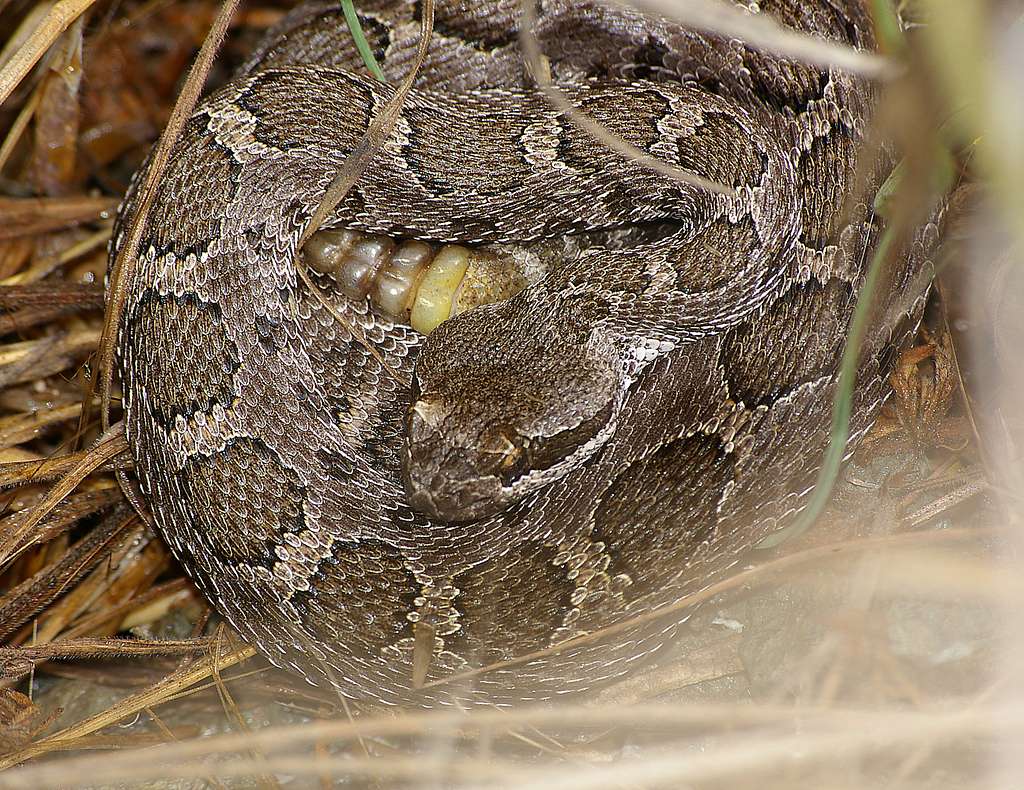
I was about 12 or 13 years old when I started working with rattlesnakes.
Northern Pacific rattlesnake • crotalus oreganus
[Sonoma Overlook Trail]
I’ve been involved in those trail systems for many years as I think you know, and before I knew who you were, I and other stewards remember having seen you off trail–which is not what we normally wouldn’t allow–but your mother being affiliated with the Ecology Center allowed you to do that, and we didn’t know who you were. If you don’t mind my telling you, we would say, “oh, I saw snake boy today.”
[Galen Freed-Wilhelm]
(Laughs)
[Sonoma Overlook Trail]
You’d be out there in your tall boots with your gear and your mom standing by to make sure you were fine. So that’s how we finally got to know you.
So you’re a snake handler and a reptile educator. Do you actually have a business as a snake handler?
[Galen Freed-Wilhelm]
Well, I don’t have an official business yet. I do occasionally do rattlesnake relocations if people find them, in their yard when they where they don’t want them and they contact me.
I also take school groups out on nature walks and teach them about snakes, reptiles and other animals.
[Sonoma Overlook Trail]
So when you relocate a snake, I understand that you can’t usually relocate them to any kind of nature preserve. So where do you usually go, and how far do you go?
[Galen Freed-Wilhelm]
That’s the tricky part in relocating a snake. You have to find a place that you can take them, and it can’t be a place where it’s just going to be a problem for someone else.
Obviously, you can’t just put them on someone else’s property.
[Sonoma Overlook Trail]
Okay.
[Galen Freed-Wilhelm]
So you just gotta figure out where there is an open place that’s not near, you know, a house or property or anything. And then you also have to make sure that it’s a good, place for the snake to live. You can’t just dump it in empty field or something. It has to be a place that has the right resources, a den site, you know, a food source, and stuff like that.
[Sonoma Overlook Trail]
I see. Do you have any education in this, field, or did you kind of self-study?
[Galen Freed-Wilhelm]
I mostly self-studied. I mean, I’ve talked with other snake handlers, other people that do rattlesnake relocation, but most of it is self-study.
[Sonoma Overlook Trail]
All right. What kinds of snakes do we find here in Sonoma County?
[Galen Freed-Wilhelm]
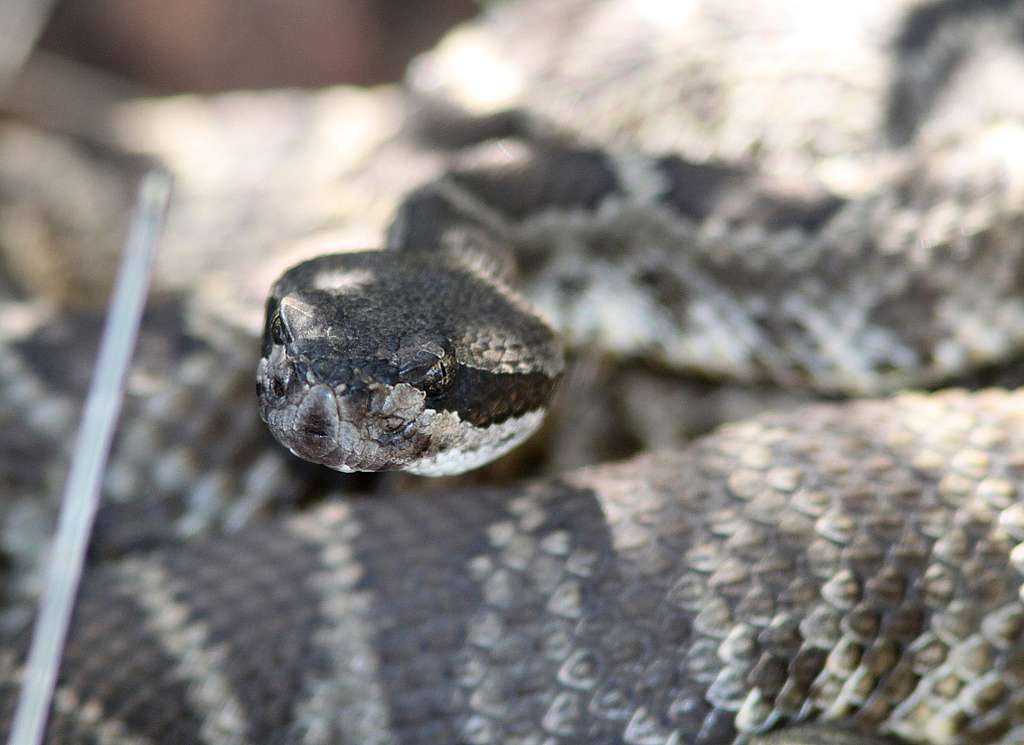
So in Sonoma County, we have about 12 to 13 different species of snakes. The common ones include the Northern Pacific rattlesnake, gopher snake, and king snake. We have three species of garter snakes. We have ring necked snakes as another common snake species. They’re pretty small; they only get, like, just over a foot long. We got sharp tailed snakes and a few others.
[Sonoma Overlook Trail]
I understand, and please correct me if I’m wrong, that the word boa tends to let you know that it’s a constricting snake…?
[Galen Freed-Wilhelm]
Yeah. So boas are a large family of snakes. We have one boa in Sonoma County, the northern rubber boa. Now all boas are constrictors, but many other snake species are constrictors.
King snakes, gopher snakes, they’re not related to boas, but they still constrict their prey the same way that a boa does.
[Sonoma Overlook Trail]
I see. I recall many years ago, on a trip to Mexico, someone putting I don’t know if it was a python or a boa on me. Pretty good size, maybe even a little bigger than Banana you have on you now. And I recall I think that was my first experience with a snake on me or handling a snake, and I recall it feeling very cool and slick and this wonderful texture. As it was moving around, I almost sensed that it was it’s somehow trying to communicate. How do snakes communicate?
[Galen Freed-Wilhelm]
So, I mean, that’s a complicated area. It’s really hard to say how much they communicate and how much they understand. They sense stuff by smelling with their tongue. Many snakes, like ball pythons, have heat-sensing pits. Then they also they do hear airborne sounds, but not very well because they have skin and scales covering their internal eardrums. It’s really hard to say how they kind of perceive us.
So snakes that are commonly kept as pets like banana, the individuals that we keep as pets are used to being handled, so they’re used to interacting with people. They don’t see us as a potential predator as they would in the wild. So if you purchase snake in the wild, it’s going to be scared because you’re a large, you know, creature, and it doesn’t know what you’re gonna do. So they’re usually scared of you. But when they get used to the interaction, it just becomes, like, part of their normal routine.
[Sonoma Overlook Trail]
Are they attracted to the heat of a human being?
[Galen Freed-Wilhelm]
They can be. So snakes are cold blooded, meaning they do not produce their own, body heat. But they don’t always like heat. People think, like, snakes always want to go to a warm spot. Being cold-blooded means they cannot regulate their body temperature, but sometimes they’re too hot, and they’ll try and find a cool place to escape the heat. Then other times, if it’s cold out, they’ll try and find a warm place to get into the heat. If a snake is, like, cold, then it might like the body heat. But if it’s, like, a hot day out, like, it’s kind of warm today, she doesn’t really need my body heat or anything, and she’s totally fine.
[Sonoma Overlook Trail]
Oh, that’s wonderful.
[Sonoma Overlook Trail]
So, when you interact with your own snakes, whom you’ve socialized, can you get any sense, in your belief that, for example, you come to one enclosure and do you sense if they want to interact with you? Do they come to you? Do they avoid you?
[Galen Freed-Wilhelm]
So each of my snakes reacts differently. Like, Pepperoni, my corn snake, I get the sense that she does not like being handled. She’s not she’s not scared of me, like, as I’m a potential predator, but she just doesn’t seem to like being moved and handled. And I think it’s just because I think she just gets nervous being lifted up, and she feels kind of insecure being off the ground and stuff.
[Sonoma Overlook Trail]
I see.
[Galen Freed-Wilhelm]
Now banana can get that way, but she’s usually a little more comfortable. Now I have four garter snakes. Two of them I raised from babies. One of them is well socialized now, so he’s very used to being handled. The other one is somewhat socialized, but for some reason, it’s still it took a long time to really get him socialized. He would always, like, freak out every time I picked him up.
[Sonoma Overlook Trail]
Is it fair to say that you keep live food around?
[Galen Freed-Wilhelm]
So I a while ago, I did keep and breed rodents. I don’t do that anymore; now I buy frozen rodents. I buy them some sometimes online. Sometimes, like, when I go to a reptile show, you can buy a whole bunch, and then sometimes you can just buy them at pet stores. And so they’re frozen, and then you just thaw them out in warm water, then you feed them to the snakes.
[Sonoma Overlook Trail]
Oh, okay. How often does that happen?
[Galen Freed-Wilhelm]
So I feed banana once a month. Actually, it’s still pretty chunky. I try to feed my garter snakes once a week. My corn snake, I try and feed every other week.
[Sonoma Overlook Trail]
So they are strictly carnivores?
[Galen Freed-Wilhelm]
Yes, snakes are 100% carnivorous. Garter snakes actually have a more varied diet. Garter snakes will eat rodents, but they’ll also eat, like, earthworms, frogs, fish, and stuff like that.
[Sonoma Overlook Trail]
Do any snakes eat other snakes?
[Galen Freed-Wilhelm]
Yes. So a lot of snakes do eat other snakes. King snake is a genus of snakes. In Sonoma County, we have two types. And they are actually called king snakes because they’re known for eating other snakes, including rattlesnakes.
[Sonoma Overlook Trail]
Interesting. So, and are king snakes a danger to human beings?
[Galen Freed-Wilhelm]
No. King snakes are totally harmless to people.
[Sonoma Overlook Trail]
So would one want to sort of attract king snakes if you had rattlesnakes around?
[Galen Freed-Wilhelm]
Probably. Yeah. A king snake is a good thing to have around.
[Sonoma Overlook Trail]
Where else have you traveled to find and see snakes?
[Galen Freed-Wilhelm]
So I’ve traveled a bunch of different places. I’ve been to Arizona, and I found and interacted with western diamondback rattlesnakes. Last year, I went to West Virginia, and I got to find a timber rattlesnake, which is a really, really cool snake. It was huge. It was about three to four feet long. And I held on to that snake for a few hours because I was, teaching a few groups about it, which was really cool. Yeah, timber rattlesnakes, they are a highly venomous snake; they’re very chill. Like, I probably had it for a few hours at least, and he never struck at me, never attempted to bite or anything like that. He just occasionally rattled and tried to get away.
[Sonoma Overlook Trail]
Have you ever been bitten?
Northern Pacific rattlesnake • crotalus oreganus
[Galen Freed-Wilhelm]
So I have never been bitten by a dangerously venomous snake. I have been bitten by many nonvenomous snakes and a number of mildly venomous snakes.
[Sonoma Overlook Trail]
So I know you wear the tall boots, and you use, what I don’t know what it’s called, but it’s a long, metal instrument with a hook at the end.
[Galen Freed-Wilhelm]
Yeah. So I have three different snake handling tools: a snake hook, which is just a metal stick with a hook, then I have two snake tongs. One is called the Midwest snake tong, which is great for picking up, like, medium to large sized rattlesnakes, and it’s very gentle. Then I have the mini machine snake tong, which is very gentle and great for picking up, like, smaller rattlesnakes.
[Sonoma Overlook Trail]
Oh, and then you use your hands sometimes, right?
[Galen Freed-Wilhelm]
Yeah. So I have used my hands. I’m always very careful, when I use my hands on rattlesnakes, and I always use the tool, at the same time.
[Sonoma Overlook Trail]
Oh, that’s a good idea.
If a snake is not coiled, can it still strike?
[Galen Freed-Wilhelm]
Yes. They can kind of well, it depends on the position that they’re in. If a snake is stretched out and you’re right in front of it, it can’t really strike forward. But if you’re behind it, it can very quickly pull back and strike at you. So I would say, especially, like, with the rattlesnake, it’s best to assume it’s always ready to strike.
[Sonoma Overlook Trail]
Another rumor that I heard–I was actually in Africa with someone and a puff adder struck at his ankle gaiter. And I believe I heard him tell me that that oftentimes snakes, when they strike, they hit the first point of contact, that’s what they bite. Is that accurate? Or would those teeth, those fangs, try to push, you know, beyond the fabric onto your flesh and try and pierce through it?
[Galen Freed-Wilhelm]
So what I’ve heard with rattlesnakes is when you’re bitten by a rattlesnake, it feels like you are punched. What they do is they open their mouth, they swing out their fangs, and they kind of hit you with them with a strong force. If you’re wearing, like, pants or something, most likely, it’ll go straight through those pants.
[Sonoma Overlook Trail]
Okay, so that was not true. That’s good to know. But do you still recommend that people wear long pants, or does it matter?
[Galen Freed-Wilhelm]
I would say it it’s probably slightly better than wearing shorts, but I would say it probably doesn’t make a real difference.
[Sonoma Overlook Trail]
Okay. This is all interesting.
You and I had a discussion the other day, and I was asking you about that I run into a lot of snakes, especially this year. I’m not sure if you’ve experienced this, but I’m hearing there are more snakes than maybe a typical year this year.
[Galen Freed-Wilhelm]
Yeah. I’ve seen a lot of snakes this year.
[Sonoma Overlook Trail]
And I walked past a full size rattlesnake, and I had always thought–I just always assumed–that the best thing to do would be to, you know, walk heavily in areas where there might be one where you can’t quite see everything and make some noise. I figured that would make them move on if they heard us coming. And you educated me that their instinct is more to stay put and use their camouflage.
[Galen Freed-Wilhelm]
Yes. That’s true. So most snakes, including rattlesnakes, their first defense is camouflage. So when you’re out hiking, the snake will almost always see you before you see it. So by the time you’ve seen it, it most likely knows you were there. And most of the time, they’ll freeze and just be completely still and hope that you walk past them.
And what people don’t realize is that in the far majority of the time, you don’t even notice them and you do walk past them. It’s only rarely when they’re out on the trail and you actually see them.
But even with rattlesnakes, biting is, by far not their first reaction and more of a last resort. So there’s actually, been studies done on rattlesnakes in Arizona, like the western diamondback rattlesnake, where people would create fake shoes, and they would go out and step on the rattlesnakes with these fake shoes. Sometimes they would even warm up the leg to really mimic a human leg, and they would report all their behaviors. And over % of the rattlesnakes did not bite as a defense. So even if you were to step on a rattlesnake, it’s still unlikely for it to bite you.
[Sonoma Overlook Trail]
So they kind of want to give you as much many chances as possible
[Galen Freed-Wilhelm]
Yeah. So every individual every individual rattlesnake is different, and it’s possible if you step on one, you know, it would just bite you straight away. But in most cases, they’re going to give you some warning. They’re gonna rattle, do something like that before they strike.
[Sonoma Overlook Trail]
And then, in the case of venomous snakes, do they always I mean, what percentage of the time are they shooting out their venom?
[Galen Freed-Wilhelm]
So most venomous snakes, including rattlesnakes, can give what are called dry bites, or they bite kind of as a warning without injecting, any venom. Now it’s hard I don’t know the exact statistics on what percent of the time they give a dry bite. I think I’ve heard it was, like, thirty percent of the time they give a dry bite, but I’m not sure on the statistics.
[Sonoma Overlook Trail]
And then the protocol, if one were to be bitten or struck by a rattlesnake or other venomous snake, is to remain calm, remain still?
[Galen Freed-Wilhelm]
Yes. So rattlesnakes have hemotoxic venom, which targets the blood. So if you’re bitten by a rattlesnake, remain calm, avoid moving as much as possible, and get to the hospital and get antivenom. The antivenom is the only treatment for a rattlesnake bite. Don’t, like, use a venom extractor or anything like that. Just get antivenom.
Now there are some snakes that are neurotoxic, like coral snakes and cobras, so you don’t want the venom to spread to your central nervous system. So you want to put, like, a tourniquet or something to restrict the venom to that limb. But you definitely do not wanna do that with a rattlesnake.
[Sonoma Overlook Trail]
Would one want to, if you’re on the trail, would you want to walk out, or would you want to call and try and get someone to get to you?
[Galen Freed-Wilhelm]
Ideally, you’d call or something and have someone get to you. If you need to walk out, you can do that, but you want to avoid walking if you can.
[Sonoma Overlook Trail]
Because it’s getting the blood flow.
[Galen Freed-Wilhelm]
Yeah. You don’t want to move and spread the blood.
[Sonoma Overlook Trail]
So some venom, it’s my understanding, sort of stays more localized, and some venom is more sort of whole body systemic?
[Galen Freed-Wilhelm]
Yeah. So well, there are all different kinds of venom compositions. With hemotoxic snakes, like a rattlesnake, it will be somewhat localized, but not like, it’ll spread up your arm. The venom will spread up your arm and stuff, and it can be pretty bad, but it’s not really going to affect your central nervous system in the same way that a neurotoxic snake would.
[Sonoma Overlook Trail]
Okay. What about other types of creatures that you study and enjoy?
Western Forest Scorpion • uroctonus mordax
[Galen Freed-Wilhelm]
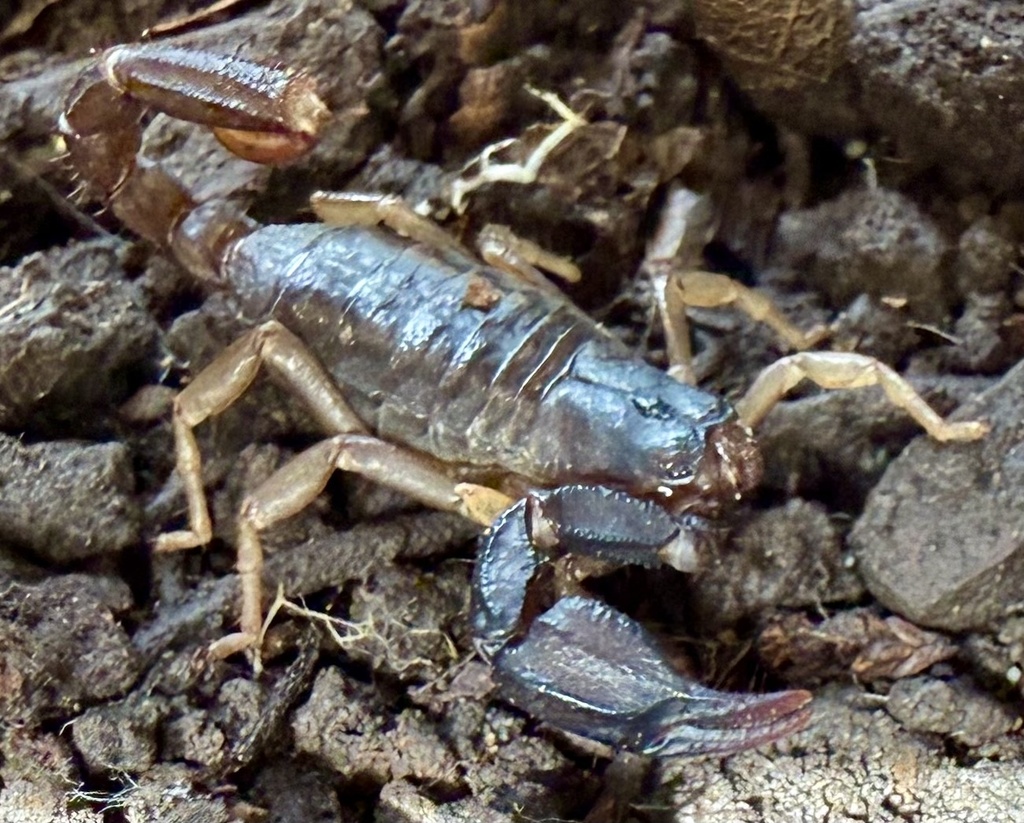
So I know a lot about scorpions. I love scorpions. I also like cockroaches, mantises, lizards, and things.
[Sonoma Overlook Trail]
What do you love about scorpions?
[Galen Freed-Wilhelm]
So I’ve always thought scorpions are really cool. Scorpions in the world, there’s over 2,000 species of scorpions. We actually have, like, four or five scorpion species here in Sonoma County. There’s a lot of misinformation about scorpions. A lot of people think scorpions are dangerous. Out of the over 2,000 scorpion species in the world, only 20-30 is actually considered dangerous to humans.
[Sonoma Overlook Trail]
But they they’re not around here?
[Galen Freed-Wilhelm]
No, not around here. So the scorpions around here, if you were to get stung by them, it would hurt, but it’s not dangerous.
[Sonoma Overlook Trail]
Kind of like a bee sting?
[Galen Freed-Wilhelm]
Kind of like a bee sting. Actually, honey bees can be more dangerous to people because their venom can trigger an allergic reaction.
[Sonoma Overlook Trail]
So do you have any other tips for people in their encounters with snakes?
[Galen Freed-Wilhelm]
Yeah. So when you’re in snake territory, it’s important to watch where you’re putting your feet and watch where you’re putting your hands. If you see a snake, all you have to do is leave it alone, and you’re in zero danger from it. I recommend giving rattlesnakes at least their body length of space. But the more space you could give them, the better.
Really just pay attention to your surroundings. And if you see a snake, leave it alone.
[Sonoma Overlook Trail]
So and, also, just with that awareness, it sounds to me like what you’re saying is that one doesn’t need to be in a state of anxiety when hiking, but this sort of stay aware enough to be able to jump back?
[Galen Freed-Wilhelm]
So, yeah, you definitely should not be, you know, scared or nervous around them, but it’s definitely something to be aware about. The far majority of people bitten by rattlesnakes are bitten because they were intentionally messing with them.
[Sonoma Overlook Trail]
Oh, I see.
[Galen Freed-Wilhelm]
So it it’s relatively rare for someone to be bitten just because they were out hiking or doing something and stumble stumbled upon a snake.
[Sonoma Overlook Trail]
I don’t think I have heard, in over twenty years of hiking the Overlook Trail, of anyone having been bitten on the Overlook or Montini. So it does seem like it’s incredibly rare if you see them here.
Where would you like to go and see snakes in the world?
[Galen Freed-Wilhelm]
So it would be cool to go to Costa Rica again. To go to the Amazon Rainforest would be cool. It would also be cool to travel to other states like Florida, Georgia. They have some cool snakes there.
[Sonoma Overlook Trail]
What about Africa?
[Galen Freed-Wilhelm]
Africa would be pretty cool. They have a lot of snakes in Africa. They have, the black mamba is a really cool snake in Africa.
[Sonoma Overlook Trail]
Very cool, very deadly. I was in Africa, and I’ve seen them. The locals are absolutely horrified.
[Galen Freed-Wilhelm]
Yeah. So black mambas are arguably the most dangerous snakes in the entire world. They’re not the most venomous, but I would say they’re probably the most dangerous. But even with black mambas, they’re not as bad as people generally think of them. They’re not going to chase you down or anything like that, but you definitely want to be aware of them and give them, you know, a lot of space.
[Sonoma Overlook Trail]
They’re they can be a little unpredictable and sneaky, I understand.
[Galen Freed-Wilhelm]
They can be, but, again, it’s not they don’t they’re not going to, like, seek you out to bite you. But if they feel cornered or threatened, they can lunge at you if they feel like you’re kind of in their space.
[Sonoma Overlook Trail]
The other snake I’ve seen, I believe it was in Costa Rica, was the fer-de-lance.
[Galen Freed-Wilhelm]
Yes. So I went to Costa Rica a few years ago, and I found and interacted with a few fer-de-lances. The fer-de-lance, I believe, is the most dangerous snake in all of The Americas–
North, Central, And South America. They’re the most dangerous snake, I think, in terms of number of injuries and fatalities.
Even them, they’re again, they’re not as, you know, mean or aggressive as people think they are, but they’re definitely very dangerous. And one of the things that makes them so dangerous is because they’re very well camouflaged, and they’re very they’re not hesitant to strike out. So it’s easy for people to step on one or step near one and for it to, you know, get scared and bite as a defense.
[Sonoma Overlook Trail]
Well, is there anything else that we should know about your reptiles and what you do with them?
[Galen Freed-Wilhelm]
Well, I teach homeschool groups about animals. I lead them in walks, and I also will bring a bunch of my pets to a homeschool group and teach them about them.
[Sonoma Overlook Trail]
And so when you have a group, do the attendees get to, you know, handle your?
[Galen Freed-Wilhelm]
Yeah. When I bring my snakes, I teach them about them, and then they can all interact with and handle them.
[Sonoma Overlook Trail]
Do we have any other predators in this area that prey on snakes?
[Galen Freed-Wilhelm]
Yeah. So a lot of animals eat snakes. Hawks and other birds of prey will eat snakes. Bobcats will eat snakes, probably coyotes, foxes, a variety of birds, and other snakes will eat them.
So snakes are actually a very important member of the of the food chain. They’re important food for a lot of animals, and they’re also very important for controlling the rodents.
And, something interesting: Rattlesnakes and ground squirrels are in what’s called a co-evolutionary arms race where the ground squirrels are evolving to be resistant to the rattlesnake’s venom, and the rattlesnakes are evolving to have stronger venom to eat the ground squirrels. Now in some of in some areas, adult rattlesnakes, ground squirrels make up to % of their diet. And in a lot of places, in Sonoma County, like at Montini and Overlook Trail, there’s a lot of ground squirrels right now, so we definitely need those rattlesnakes eating the ground squirrels.
[Sonoma Overlook Trail]
We have a lot, yes. It’s a huge it’s a huge issue there.
[Sonoma Overlook Trail]
Well, I want to thank you so much for being here and letting me interview you, and I will be seeing you soon on the trail, I know. Thanks a lot, Galen.
[Galen Freed-Wilhelm]
Thank you.
[Sonoma Overlook Trail]
Bye, Banana.
[Galen Freed-Wilhelm]
Bye.
*Observe from all creatures from a distance and do not interfere; this protects both the creature and human safety. Wildlife and habitat on Sonoma Overlook Trail and Montini Open Space Preserve must remain undisturbed by the public, and visitors are not allowed off-trail.
 Sonoma Overlook Trail • Montini Open Space Preserve
Great conversation. . . .I learned a lot about snakes. Couldn’t take my eyes off of Galen and Banana!
LikeLike
Thanks, Jeni! Same here….
LikeLike