
Moving boulders is a science
A hardy band of young men and women from California, Florida, Illinois and other states spent 12 weeks earlier this year solving hard problems — large sections of bare, rough rock in the Overlook trail bed.
As regular users know, the upper trail was closed between the Toyon Junction and the summit during the project. What went on beyond the “Trail Closed” tape? Every morning, a six-person crew from American Conservation Experience arrived around 7:30 a.m. from their campsite at Sugarloaf, did the daily stretch, and discussed the day’s plan. Then they hiked up to the site.
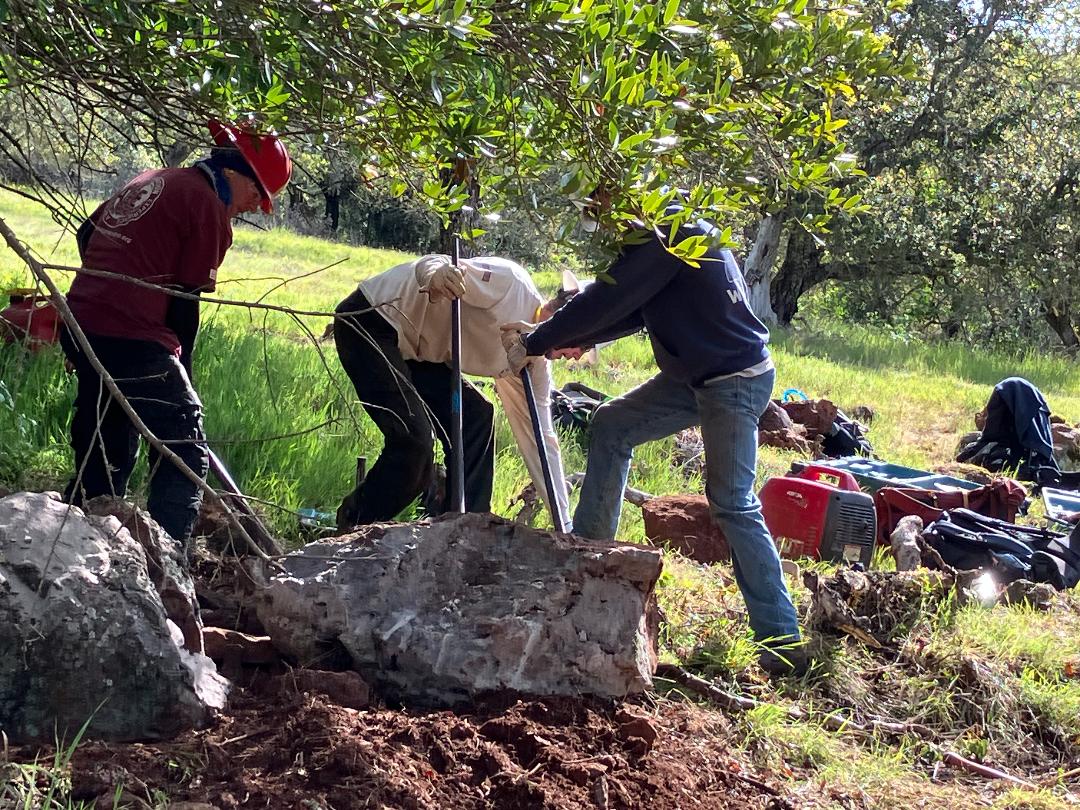
They brought with them little in the way of mechanical aids: a mechanical wheelbarrow, and generators for a rock drill and rock hammer. All else was hand tools: Pulaski’s, McLeod’s, sledgehammers, a compactor, chisels, shovels, dollies, buckets and straps. Most of the work was done by hand, and much of the material dragged, levered, shoveled into buckets, strapped on a dolly and hauled over the trail to the worksite where it was hand worked and positioned. Significant quantities of rock were gathered and worked on site.
Sometimes progress was excruciatingly slow, and the crew would only complete just a few yards over the course of a 10 hour-day. It’s well known that you never really know what’s underneath until you start digging, and that is true even when a big basalt outcrop is staring you in the face. Once the trail bed is exposed you may need to start two yards sooner, or put in two steps, not one and a landing. The final design emerges as work proceeds. Fred Allebach, our quality control guy and problem solver, helped keep spirits and pace high.
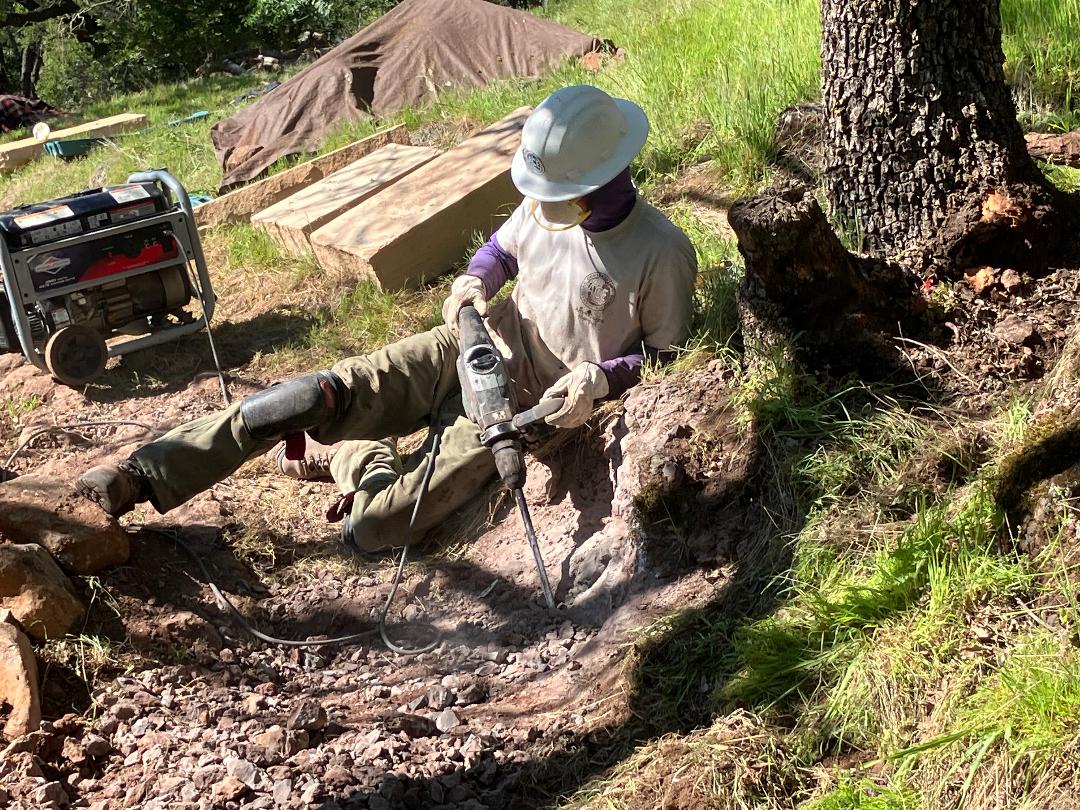
Employing a rock chisel
One morning, the crew arrived to find that vandals had wrecked the steps and retaining wall they built over the previous days and rolled equipment and materials, including a 400-pound step slab, down the hill side. The crew got busy retrieving the materials (it was uphill all the way) and re-doing their work and just kept going.
The crew is from ACE (American Conservation Experience), the same organization we used on the previous two Overlook projects in 2018 and 2022, knowing they would bring the right tools, know-how and the right attitude to the job. They soldiered on through 6 hitches – 8 days straight of 10 hours, followed by 6 days off.
In the end we remodeled about 350 feet of trail, laid 58 steps, at least twice as many gargoyles (large rocks that pin a step to prevent sideways movement), about 12 cubic yards of aggregate and uncountable quantities of rubble rock as retainers and water diverters. All this and a day ahead of schedule just under budget! No wonder they look happy as they pose on the last segment – perhaps their tour de force.
Contributed by Bill Wilson and Mary Nesbitt
 Sonoma Overlook Trail • Montini Open Space Preserve